
The Future of Performance Reviews: AI Roleplay Training
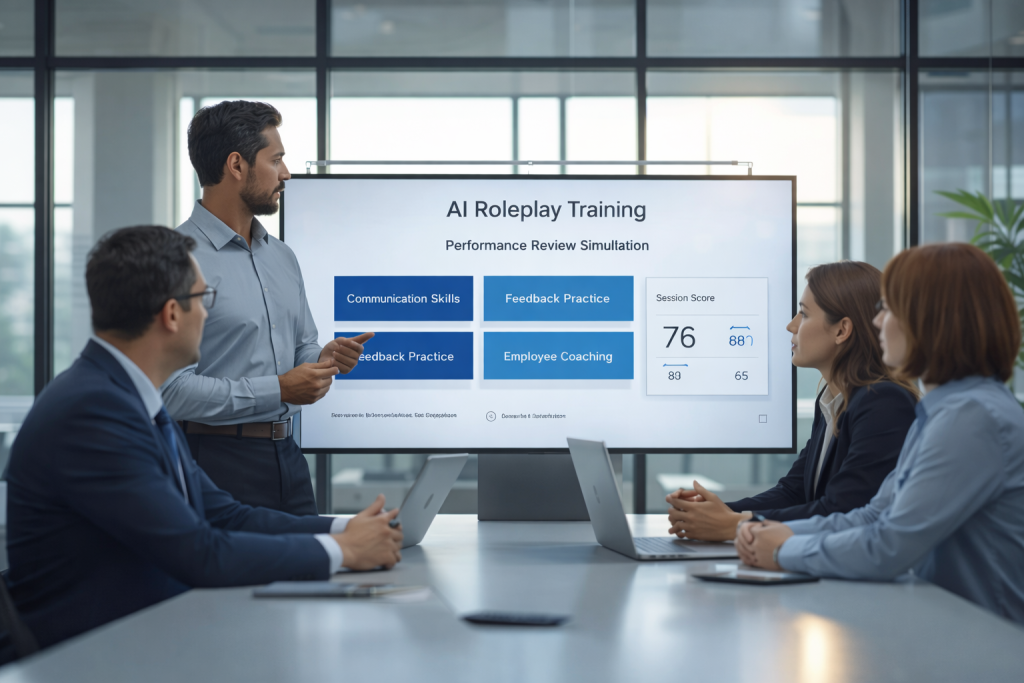
Performance reviews are one of the most emotionally charged responsibilities managers face. They affect compensation, promotion, trust, and long-term engagement. Yet despite years of investment in performance review training and difficult conversations training, managers still enter review season anxious and underprepared. Most training focuses on frameworks, documentation, and process, while far fewer programs help managers practice staying composed, delivering clarity under pressure, and responding constructively when emotions rise. Performance reviews are not informational events. They are leadership stress tests. The next evolution of the manager training program is not more theory. It is deliberate, repeatable practice that prepares managers for the real conversation before it happens. Rethinking the Purpose of a Manager Training Program Traditional manager training programs tend to emphasize three primary areas: All of these are important. Managers need to understand compliance requirements, organizational expectations, and structured feedback models. However, performance reviews consistently expose a deeper gap: execution under pressure. A manager may understand the company’s performance rubric and know how to structure a feedback conversation. But when an employee reacts with disappointment, anger, confusion, or defensiveness, the manager’s ability to execute becomes the true differentiator. The real question is not whether the manager knows the model. It is whether the manager can deliver the message calmly, clearly, and constructively when it matters most. The Confidence Gap in Performance Review Training One of the most overlooked challenges in performance review training is confidence. Managers frequently report: These behaviors are rarely caused by a lack of knowledge. They are symptoms of insufficient rehearsal. Performance review training typically introduces frameworks and example conversations, but managers rarely get enough practice to internalize them. A manager might roleplay once in a workshop and then be expected to execute months later during review season. That gap between exposure and execution is where anxiety resurfaces. Why Difficult Conversations Training Often Stops Too Soon Difficult conversations training frequently follows a predictable structure: a workshop, a slide deck of conversation models, and a brief peer roleplay. Then managers return to their roles with limited reinforcement, with predicable disappointing results including: Workshops are effective for building shared language and introducing frameworks, yet skill development requires repetition, feedback, and gradual increases in complexity. Without reinforcement, retention drops quickly and behavioral transfer becomes inconsistent. Anxiety resurfaces before real conversations, and managers revert to instinct instead of skill. A New Layer in the Manager Training Program: Conversation Simulation Performance reviews are scenario-driven, and context can shift dramatically. Managers may face: Each situation demands nuanced execution. Tone, clarity, empathy, firmness, and pacing must adjust dynamically. Rather than relying on a single practice session, managers should progress through increasing levels of complexity: This progression mirrors how competence develops in any performance domain. Simulation introduces a practical bridge between theory and execution. Managers can rehearse realistic scenarios before stepping into live meetings. They test responses, refine language, and build comfort with emotional variability. Conversation simulation transforms performance review training from a conceptual exercise into an experiential one. Managers enter review season with rehearsed clarity and new habit/muscle memory instead of relying solely on memory. To see how simulation supports real leadership conversations, watch the video below for an example of how Virtual Sapiens enables managers to practice high-stakes communication before it happens live: How AI Roleplay Elevates Performance Review Training AI roleplay strengthens performance review training by enabling safe, repeatable simulation of real-world conversations. Through Virtual Sapiens’ platform, managers can practice friction points in real time before stepping into live meetings. Performance reviews often hinge on micro-decisions. Managers must decide how to respond when an employee disagrees, when to pause versus push forward, and how to clarify expectations without escalating tension. AI simulation allows managers to experiment safely and refine their responses before stakes are real. AI roleplay also separates message from delivery. Many managers craft strong messages but undermine them through hesitation, over-apologizing, defensive tone, or inconsistent body language. Structured feedback helps managers improve: This shifts performance review training from abstract advice to measurable behavioral improvement. Embedding Practice Into the Workflow of a Manager Training Program The future of manager training programs will not rely solely on annual workshops. Practice must be embedded into workflow. Organizations can introduce simulation at high-impact moments: Short, focused practice sessions compound over time. Ten minutes of rehearsal repeated consistently creates stronger behavioral retention than a single high-effort event without reinforcement. Embedding practice increases relevance because managers prepare close to real events. It increases adoption because the connection to immediate needs is clear. It increases sustainability because reinforcement becomes habitual rather than episodic. Organizational Impact: Beyond Individual Conversations Upgrading performance review training strengthens more than a single meeting. It strengthens the communication infrastructure of the organization, resulting in: When simulation is paired with human coaching, impact deepens. Our Ariel Group case study demonstrates how combining scalable rehearsal with expert facilitation transforms leadership development outcomes. Designing a Modern Performance Review Training Initiative Organizations can implement experiential performance review training through a structured approach. Experiential Manager Training Programs Are the Next Step in Leadership Performance reviews will always carry emotional weight, but anxiety decreases when preparation increases. The next generation of manager training programs will move beyond policy and toward experiential learning. Performance review training and difficult conversations training become durable when managers practice before they perform. AI roleplay introduces a scalable simulation layer that helps managers build composure, clarity, and confidence. Organizations ready to modernize their approach can begin by embedding rehearsal into existing programs rather than adding more content. Click here to get started. Frequently Asked Questions What should a manager training program include? A comprehensive manager training program should include: Why is performance review training important? Performance reviews influence compensation, engagement, retention, and trust. Managers need structured practice to deliver clear, constructive feedback under emotional pressure. How does AI roleplay improve performance review training? AI roleplay enables realistic rehearsal before live meetings, repetition in a low-risk environment, behavioral feedback on delivery, and increased confidence through structured practice.