
Why Experiential Learning Is the New Baseline for Coaches, Facilitators, and Leaders
Experiential learning has always been the gold standard for building communication and leadership skills. People develop capability through practice, feedback, and repetition, not through passive content or one-time workshops. Unfortunately, coaches and facilitators are often restricted to a single session with their clients, making true experiential learning at scale a structural challenge.
There is only so much that coaches or leaders in L&D can review, so many sessions that can be scheduled, and so much follow-through that can be managed manually. The Virtual Sapiens AI Coach Assistant changes that equation by automating the reinforcement layer that experiential learning depends on, making it possible to deliver consistent, personalized development at a scale that was previously out of reach.
Roleplay Is Where Practice Starts. Reinforcement Is Where Skills Stick.
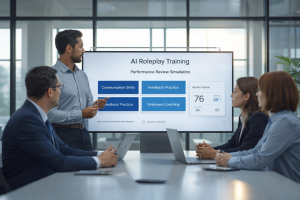
Training and coaching programs have rallied around AI roleplay as a breakthrough, and for good reason. The ability to simulate difficult conversations on demand, without scheduling overhead or social risk, is genuinely transformative. Clients can practice feedback conversations, executive presentations, and high-pressure negotiations in a private, low-stakes environment. That is a meaningful advancement over peer roleplay and call reviews.
But here is the challenge coaches & leaders are running into: participants who complete roleplays still disengage between sessions. They complete a scenario, receive feedback, and then return to the demands of daily work, where practice quickly drops off the priority list. The momentum built in a session or workshop evaporates within days, not weeks.
True experiential learning does not end when a session ends. It requires repeated cycles of practice, reflection, feedback, and application over time. Roleplay creates the first cycle. Sustaining that cycle at scale is where most AI coaching platforms fall short, and where the AI Coach Assistant fills a critical gap.
Introducing the AI Coach Assistant: Your Personalized AI Coaching and Learning Platform
The gap between session engagement and between-session drift is precisely what the Virtual Sapiens AI Coach Assistant was built to close.
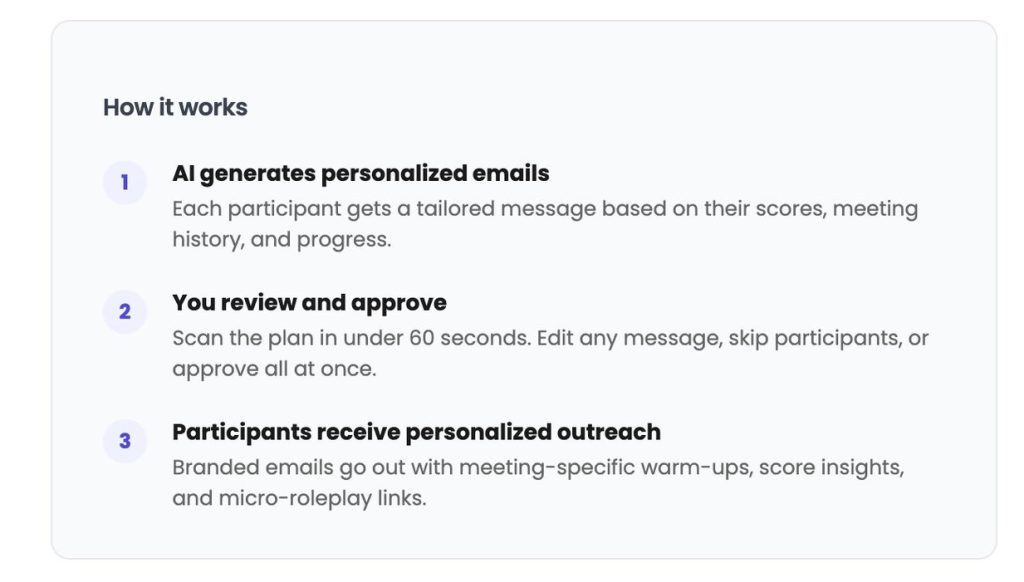
Rather than relying on coaches or program managers to manually identify who needs a nudge and craft individual follow-up messages, the AI Coach Assistant automates that entire layer without sacrificing the personalization that makes coaching meaningful.
Here is how it works: the system draws on each participant’s actual scores, session history, and overall progress to draft tailored coaching emails and weekly practice plans. No generic mass reminders. No one-size-fits-all nudges. Each participant receives communication that reflects where they are, what they need to work on, and what their next step should be. That is experiential learning infrastructure, built for scale.
For Facilitators and Program Leaders
The AI Coach Assistant removes the operational burden of managing engagement:
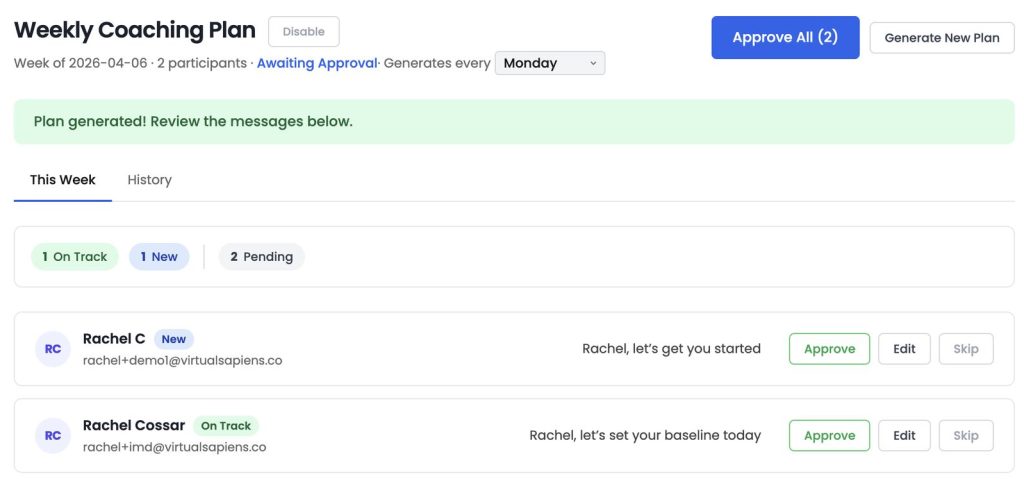
- Weekly coaching plans are drafted for entire cohorts automatically. Facilitators can review, edit, and send in minutes rather than hours.
- Clear visibility into who is on track, who is new, and who is falling behind, without manual tracking.
- Flexible scheduling to align with each program’s cadence and structure.
- Easy resubscribe management to re-engage participants who have gone quiet.
For Participants
The experience shifts from passive notification to personalized practice reinforcement:
- Coaching that reflects their actual performance, not a template built for someone else.
- Clear, actionable next steps tied to real progress and real skill gaps.
- Full control over communication preferences, so engagement feels like support rather than surveillance.
This is not just an automation feature. It is a structural shift in how coaching firms can deliver consistent, high-quality experiential learning at scale, without burning out their people or inflating their overhead.
The Hidden Tax on Coaching & Training Efficiency
Every coaching or training program faces some version of the same invisible drain. Facilitators spend time chasing participation. Program managers send manual follow-up emails. Coaches review who is active and who has gone quiet. Leaders manage check-in routines that are time-consuming to maintain and inconsistent in quality.
None of this is high-value work, but it is essential work. Without it, engagement falls apart. The problem is structural. Most AI coaching platforms are built to deliver practice, not to sustain it. They assume participants will return consistently on their own, which research on behavior change tells us is unlikely without external prompts, accountability structures, and personalized reinforcement.
The result is that coaches and L&D leaders end up using human time to do what systems should be doing. Senior coaches and program managers become de facto engagement managers, spending capacity on logistics instead of transformation. That is not a sustainable model for scale.
What Experiential Learning Actually Requires
Experiential learning theory has been consistent on this point for decades: lasting skill development requires more than a single exposure. Whether it is Kolb’s learning cycle or more recent research on deliberate practice, the evidence points to the same conclusion. Skills are built through repeated cycles of experience, reflection, feedback, and application.
A workshop creates the first cycle. A training session deepens it. But without reinforcement in between, without structured prompts to return to practice, apply concepts, and receive feedback again, the cycle breaks. Participants stop at awareness and never reach fluency.
For a true experiential learning model to work, the AI coaching platform must provide:
- Repeated, realistic practice opportunities (this is where roleplay delivers)
- Timely feedback tied to actual performance, not generic templates
- Personalized guidance that reflects where each learner actually is in their development
- Accountability structures that keep people returning to practice without requiring manual effort from coaches
Most AI coaching platforms solve the first point. Very few solve all four. That gap is where the real opportunity for coaching firms lies, and where Virtual Sapiens has built something meaningfully different.
Why This Changes the ROI Conversation for Coaching Firms
Enterprise buyers are not just purchasing access to a practice platform. They are purchasing outcomes. And outcomes in coaching, including improved communication effectiveness, stronger leadership presence, and measurable skill growth, require sustained experiential learning over time, not a single burst of activity at program launch.
When coaching firms can demonstrate that their program maintains consistent participant engagement week over week, the ROI conversation changes fundamentally. Instead of defending the value of a platform based on completion rates or session counts, firms can present data on practice frequency, skill progression, and behavioral improvement over time.
The AI Coach Assistant directly supports that story. By automating personalized reinforcement, it increases the likelihood that participants return to practice consistently. More practice means more data. More data means stronger analytics. Stronger analytics means a defensible ROI narrative that holds up in renewal conversations and budget reviews.
For coaching firms looking to win larger enterprise contracts and retain them, this kind of systematic experiential learning infrastructure is no longer optional. It is a competitive requirement.
Protecting Time Without Sacrificing Quality
One of the most consistent concerns coaches and leaders raise about scaling is the fear of diluting quality. Hiring and training new facilitators is slow and expensive. Maintaining consistent standards across a growing associate network is genuinely difficult. Senior facilitators are already stretched, reviewing recordings, giving foundational feedback, and managing client check-ins, leaving less time for the high-order work that actually drives transformation.
The AI Coach Assistant addresses this directly. By handling the engagement layer, drafting personalized coaching plans, sending practice reminders, and surfacing who needs attention and why, it frees coaches from the administrative and logistical work that currently consumes significant bandwidth.
Facilitators can focus on what they do best: delivering insight, building relationships, and guiding clients through the deeper dimensions of leadership and communication development. The AI handles repetition and reinforcement. Coaches handle depth and strategy. That division of labor is what makes experiential learning sustainable at scale without burnout or quality erosion.
This is the core promise of AI as augmentation rather than replacement. It is not about doing more with fewer humans. It is about enabling humans to do their best work, consistently and at a scale that was previously impossible.
Building a Practice Cadence That Actually Sticks
Behavior change research is unambiguous: frequency of practice matters more than intensity of single events. A client who practices for ten minutes three times a week will develop communication skills faster and more durably than a client who completes a two-hour roleplay session once a month.
The challenge for learning managers has always been creating the conditions for frequent practice without requiring proportional increases in review time. The AI Coach Assistant solves that problem by making consistent engagement the default rather than the exception.
When participants receive personalized, timely communications based on their actual progress, the psychological barriers to returning, including uncertainty about what to work on, lack of accountability, and momentum loss, are systematically reduced. The AI coaching platform becomes a proactive learning partner rather than a passive practice library.
Over time, this compounding effect is what separates programs that produce real behavior change from programs that produce positive survey responses. The difference is not the quality of content or the sophistication of the roleplay scenarios. It is the presence of a consistent, personalized experiential learning structure that keeps participants active between human touchpoints.
The Platform That Makes Experiential Learning Scale
Virtual Sapiens was built around a straightforward belief: training only works if it leads to behavior change. AI roleplay creates the conditions for practice. The AI Coach Assistant creates the conditions for consistency. Together, they form an experiential learning infrastructure that gives coaching firms what they have always needed but rarely had, which is a scalable way to maintain engagement, reinforce development, and prove outcomes over time.
For coaching firms ready to move beyond table stakes and deliver a differentiated, measurable client experience, Virtual Sapiens provides the AI coaching platform and the infrastructure to make that possible.
Ready to see how it works? Try Virtual Sapiens for free and experience the full platform, from AI roleplay to personalized coaching plans.
Frequently Asked Questions
What is experiential learning in the context of coaching?
Experiential learning is a skill development approach built on repeated cycles of practice, feedback, reflection, and application. In coaching, it means moving beyond passive content and one-time workshops to give participants structured, realistic practice opportunities that compound over time. The most effective experiential learning programs combine live coaching with technology that sustains practice and reinforcement between sessions.
What is the AI Coach Assistant?
The Virtual Sapiens AI Coach Assistant is a feature that automatically drafts personalized coaching emails and weekly practice plans for each participant based on their actual scores, session history, and progress. Facilitators can review, edit, and send these plans in minutes, removing the manual effort of managing cohort engagement at scale.
What is an AI coaching platform?
An AI coaching platform uses artificial intelligence to support communication and leadership skill development through tools like roleplay simulation, real-time feedback, progress analytics, and automated engagement features. The most effective platforms go beyond practice delivery to actively support consistent participation and measurable skill improvement over time.
How does the AI Coach Assistant support experiential learning?
Experiential learning requires repeated practice, timely feedback, and consistent reinforcement. The AI Coach Assistant sustains all three by automatically sending participants personalized coaching communications based on their actual progress. This keeps the experiential learning cycle active between coaching sessions without adding manual workload for facilitators or coaches.
Does AI replace human coaches on the Virtual Sapiens platform?
No. Virtual Sapiens is designed as a coaching multiplier, not a coach replacement. AI handles the repetition, reinforcement, and engagement layer so coaches, facilitators, and learning leaders can focus on the insight, relationship-building, and strategic guidance that drives real transformation. The platform augments coaching capacity without diluting coaching quality.
How do I get started with Virtual Sapiens?
You can start a free trial to explore the full platform, including AI roleplay, video analysis, skill assessments, and the AI Coach Assistant. Enterprise and partner configurations are available for coaching firms ready to deploy at scale.