
Beyond the Bot: AI Practice Systems And Lasting Change

AI practice systems have proliferated quickly. Most organizations experimenting with communication or leadership development have encountered at least one, and most have noticed the same thing: the experience often feels shallow, inconsistent, or easy to abandon. Participants try a session, find it mildly interesting, and then never return. The technology works in the narrow sense (a conversation happens) but it doesn’t work in the meaningful sense. Skills don’t improve. Behavior doesn’t change. The real question is not whether effective AI practice systems exist. It’s what separates a tool that genuinely develops skills from one that only simulates the appearance of practice. The Problem With Baseline Bots in AI Practice Systems Not all AI roleplay is created equal, and the gap between a well-designed AI communication coaching platform and a generic chatbot is significant. Many tools currently marketed as AI roleplay training are, at their core, thin wrappers around large language models. They can generate conversational responses, but they lack the structure, consistency, and behavioral depth that real skill development requires. Common limitations of baseline bots include: The result is a “try once, never return” experience. Initial curiosity gives way to disengagement, and the platform quietly becomes shelfware. For organizations investing in communication or leadership development, this outcome is entirely avoidable when the right design principles are in place. Why Real Skill Development Requires More Than a Chatbot Communication is not a knowledge problem. Most professionals already understand what good communication looks like. The gap is behavioral: showing up with clarity, confidence, and presence in real conversations, under pressure, consistently over time. Behavioral skills are built through repetition, feedback, and progression, not through a single exposure or a one-off roleplay session. Real conversations are cumulative. People build context, recognize patterns, and adjust their behavior based on experience over time. Without that same accumulation in AI roleplay training, practice remains isolated and the learning loop never closes. Generic AI tools treat each interaction as an event. Effective AI coaching platforms treat each interaction as a step in a longer development journey. That distinction is what separates tools that produce engagement metrics from tools that produce behavior change. The Missing Layer: Continuity in AI Coaching One of the most significant structural limitations of most AI communication coaches is the absence of continuity. Every session resets. There is no memory of what was practiced last week, no awareness of which patterns keep recurring, and no sense of how far a participant has come. This breaks the learning loop. Skill development requires pattern recognition across time, not isolated practice events. A coach who works with a client over six months accumulates a nuanced understanding of that person’s tendencies, growth edges, and progress. AI roleplay that resets with every session cannot replicate that continuity, and without it, the experience feels like meeting a new coach every time. This is precisely where purpose-built AI coaching platforms diverge from generic chatbots. Continuity is not a nice-to-have feature. It is a prerequisite for longitudinal skill development. What Makes AI Practice Systems Feel Real: Key Design Principles Building an AI roleplay experience that genuinely develops skills requires deliberate design across five dimensions. Each addresses a gap that generic tools consistently leave open. 1. Persistent Memory and Longitudinal Practice Effective AI roleplay training builds on prior conversations. The AI retains context, past performance, and interaction history, creating learning journeys instead of one-off sessions. Users experience progressive challenge and skill refinement rather than starting from scratch each time. This sense of continuity and accountability is what keeps participants returning and what allows development to compound over time. 2. Deep Persona Customization Real conversations are shaped by specific contexts, personalities, and stakes. Effective AI roleplay training requires the ability to define conversation scenarios precisely: who the other person is, what their history and motivations are, how they respond to pushback, and what the emotional stakes involve. Without this level of persona design, conversations feel artificial and the practice transfers poorly to real-world situations. 3. Structured, Consistent Feedback Systems Feedback that changes randomly between sessions does not build trust or support learning. Effective AI communication coaching platforms provide standardized evaluation frameworks that assess performance consistently across verbal content, vocal delivery, and non-verbal behavior. Clear, actionable feedback tied to measurable criteria is what allows participants to understand where they are, what to adjust, and whether they are improving. 4. Guardrails and Enterprise-Ready Design Unstructured AI can produce unreliable or inappropriate outputs, particularly in sensitive communication contexts like performance conversations, feedback delivery, or leadership scenarios. Enterprise deployment requires defined behavioral boundaries, alignment to coaching and communication best practices, and compliance with security and privacy standards. This is the difference between experimentation and production-grade deployment. 5. Engagement Loops That Drive Ongoing Practice The biggest challenge in AI roleplay training is not access. It is sustained usage. Most participants disengage not because the tool is broken, but because there is no compelling reason to return. Effective platforms build engagement loops: timely practice nudges tied to real upcoming conversations, visible progress and improvement, and clear reasons to come back. When practice becomes part of the workflow rather than an additional task, adoption compounds. The Between-Session Gap: Where Our AI Coach Assistant Steps Up Even organizations using well-designed AI roleplay tools encounter a consistent pattern: participants engage strongly during a program launch or workshop, complete initial roleplays, and then drift. Without structure to sustain practice between live interactions, the momentum built in sessions evaporates within days. This is a structural problem, not a motivation problem. Kolb’s learning cycle and more recent deliberate practice research are consistent on this point: lasting skill development requires repeated cycles of practice, feedback, reflection, and application. A single burst of activity at program launch is not enough. The platform must actively support re-engagement between human touchpoints. This is the gap that the Virtual Sapiens AI Coach Assistant was built to close. Rather than waiting for participants to return on their own, the AI Coach Assistant automatically drafts personalized coaching emails and weekly practice plans
The AI Coach Assistant: Redefining Experiential Learning at Scale

Why Experiential Learning Is the New Baseline for Coaches, Facilitators, and Leaders Experiential learning has always been the gold standard for building communication and leadership skills. People develop capability through practice, feedback, and repetition, not through passive content or one-time workshops. Unfortunately, coaches and facilitators are often restricted to a single session with their clients, making true experiential learning at scale a structural challenge. There is only so much that coaches or leaders in L&D can review, so many sessions that can be scheduled, and so much follow-through that can be managed manually. The Virtual Sapiens AI Coach Assistant changes that equation by automating the reinforcement layer that experiential learning depends on, making it possible to deliver consistent, personalized development at a scale that was previously out of reach. Roleplay Is Where Practice Starts. Reinforcement Is Where Skills Stick. Training and coaching programs have rallied around AI roleplay as a breakthrough, and for good reason. The ability to simulate difficult conversations on demand, without scheduling overhead or social risk, is genuinely transformative. Clients can practice feedback conversations, executive presentations, and high-pressure negotiations in a private, low-stakes environment. That is a meaningful advancement over peer roleplay and call reviews. But here is the challenge coaches & leaders are running into: participants who complete roleplays still disengage between sessions. They complete a scenario, receive feedback, and then return to the demands of daily work, where practice quickly drops off the priority list. The momentum built in a session or workshop evaporates within days, not weeks. True experiential learning does not end when a session ends. It requires repeated cycles of practice, reflection, feedback, and application over time. Roleplay creates the first cycle. Sustaining that cycle at scale is where most AI coaching platforms fall short, and where the AI Coach Assistant fills a critical gap. Introducing the AI Coach Assistant: Your Personalized AI Coaching and Learning Platform The gap between session engagement and between-session drift is precisely what the Virtual Sapiens AI Coach Assistant was built to close. Rather than relying on coaches or program managers to manually identify who needs a nudge and craft individual follow-up messages, the AI Coach Assistant automates that entire layer without sacrificing the personalization that makes coaching meaningful. Here is how it works: the system draws on each participant’s actual scores, session history, and overall progress to draft tailored coaching emails and weekly practice plans. No generic mass reminders. No one-size-fits-all nudges. Each participant receives communication that reflects where they are, what they need to work on, and what their next step should be. That is experiential learning infrastructure, built for scale. For Facilitators and Program Leaders The AI Coach Assistant removes the operational burden of managing engagement: For Participants The experience shifts from passive notification to personalized practice reinforcement: This is not just an automation feature. It is a structural shift in how coaching firms can deliver consistent, high-quality experiential learning at scale, without burning out their people or inflating their overhead. The Hidden Tax on Coaching & Training Efficiency Every coaching or training program faces some version of the same invisible drain. Facilitators spend time chasing participation. Program managers send manual follow-up emails. Coaches review who is active and who has gone quiet. Leaders manage check-in routines that are time-consuming to maintain and inconsistent in quality. None of this is high-value work, but it is essential work. Without it, engagement falls apart. The problem is structural. Most AI coaching platforms are built to deliver practice, not to sustain it. They assume participants will return consistently on their own, which research on behavior change tells us is unlikely without external prompts, accountability structures, and personalized reinforcement. The result is that coaches and L&D leaders end up using human time to do what systems should be doing. Senior coaches and program managers become de facto engagement managers, spending capacity on logistics instead of transformation. That is not a sustainable model for scale. What Experiential Learning Actually Requires Experiential learning theory has been consistent on this point for decades: lasting skill development requires more than a single exposure. Whether it is Kolb’s learning cycle or more recent research on deliberate practice, the evidence points to the same conclusion. Skills are built through repeated cycles of experience, reflection, feedback, and application. A workshop creates the first cycle. A training session deepens it. But without reinforcement in between, without structured prompts to return to practice, apply concepts, and receive feedback again, the cycle breaks. Participants stop at awareness and never reach fluency. For a true experiential learning model to work, the AI coaching platform must provide: Most AI coaching platforms solve the first point. Very few solve all four. That gap is where the real opportunity for coaching firms lies, and where Virtual Sapiens has built something meaningfully different. Why This Changes the ROI Conversation for Coaching Firms Enterprise buyers are not just purchasing access to a practice platform. They are purchasing outcomes. And outcomes in coaching, including improved communication effectiveness, stronger leadership presence, and measurable skill growth, require sustained experiential learning over time, not a single burst of activity at program launch. When coaching firms can demonstrate that their program maintains consistent participant engagement week over week, the ROI conversation changes fundamentally. Instead of defending the value of a platform based on completion rates or session counts, firms can present data on practice frequency, skill progression, and behavioral improvement over time. The AI Coach Assistant directly supports that story. By automating personalized reinforcement, it increases the likelihood that participants return to practice consistently. More practice means more data. More data means stronger analytics. Stronger analytics means a defensible ROI narrative that holds up in renewal conversations and budget reviews. For coaching firms looking to win larger enterprise contracts and retain them, this kind of systematic experiential learning infrastructure is no longer optional. It is a competitive requirement. Protecting Time Without Sacrificing Quality One of the most consistent concerns coaches and leaders raise about scaling is the fear
The Future of Performance Reviews: AI Roleplay Training
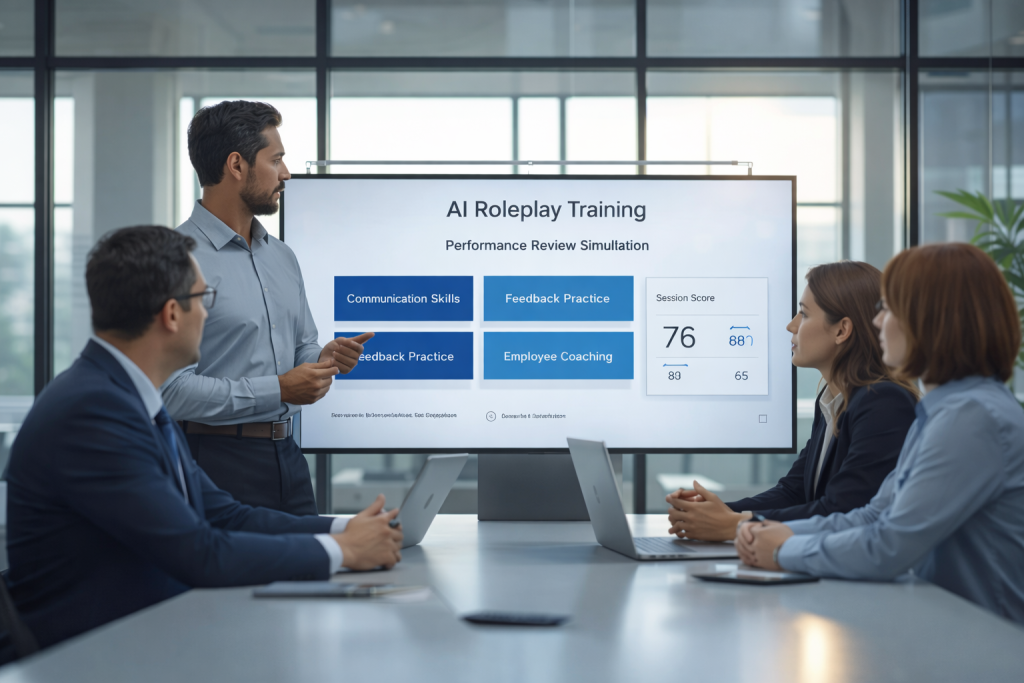
Performance reviews are one of the most emotionally charged responsibilities managers face. They affect compensation, promotion, trust, and long-term engagement. Yet despite years of investment in performance review training and difficult conversations training, managers still enter review season anxious and underprepared. Most training focuses on frameworks, documentation, and process, while far fewer programs help managers practice staying composed, delivering clarity under pressure, and responding constructively when emotions rise. Performance reviews are not informational events. They are leadership stress tests. The next evolution of the manager training program is not more theory. It is deliberate, repeatable practice that prepares managers for the real conversation before it happens. Rethinking the Purpose of a Manager Training Program Traditional manager training programs tend to emphasize three primary areas: All of these are important. Managers need to understand compliance requirements, organizational expectations, and structured feedback models. However, performance reviews consistently expose a deeper gap: execution under pressure. A manager may understand the company’s performance rubric and know how to structure a feedback conversation. But when an employee reacts with disappointment, anger, confusion, or defensiveness, the manager’s ability to execute becomes the true differentiator. The real question is not whether the manager knows the model. It is whether the manager can deliver the message calmly, clearly, and constructively when it matters most. The Confidence Gap in Performance Review Training One of the most overlooked challenges in performance review training is confidence. Managers frequently report: These behaviors are rarely caused by a lack of knowledge. They are symptoms of insufficient rehearsal. Performance review training typically introduces frameworks and example conversations, but managers rarely get enough practice to internalize them. A manager might roleplay once in a workshop and then be expected to execute months later during review season. That gap between exposure and execution is where anxiety resurfaces. Why Difficult Conversations Training Often Stops Too Soon Difficult conversations training frequently follows a predictable structure: a workshop, a slide deck of conversation models, and a brief peer roleplay. Then managers return to their roles with limited reinforcement, with predicable disappointing results including: Workshops are effective for building shared language and introducing frameworks, yet skill development requires repetition, feedback, and gradual increases in complexity. Without reinforcement, retention drops quickly and behavioral transfer becomes inconsistent. Anxiety resurfaces before real conversations, and managers revert to instinct instead of skill. A New Layer in the Manager Training Program: Conversation Simulation Performance reviews are scenario-driven, and context can shift dramatically. Managers may face: Each situation demands nuanced execution. Tone, clarity, empathy, firmness, and pacing must adjust dynamically. Rather than relying on a single practice session, managers should progress through increasing levels of complexity: This progression mirrors how competence develops in any performance domain. Simulation introduces a practical bridge between theory and execution. Managers can rehearse realistic scenarios before stepping into live meetings. They test responses, refine language, and build comfort with emotional variability. Conversation simulation transforms performance review training from a conceptual exercise into an experiential one. Managers enter review season with rehearsed clarity and new habit/muscle memory instead of relying solely on memory. To see how simulation supports real leadership conversations, watch the video below for an example of how Virtual Sapiens enables managers to practice high-stakes communication before it happens live: How AI Roleplay Elevates Performance Review Training AI roleplay strengthens performance review training by enabling safe, repeatable simulation of real-world conversations. Through Virtual Sapiens’ platform, managers can practice friction points in real time before stepping into live meetings. Performance reviews often hinge on micro-decisions. Managers must decide how to respond when an employee disagrees, when to pause versus push forward, and how to clarify expectations without escalating tension. AI simulation allows managers to experiment safely and refine their responses before stakes are real. AI roleplay also separates message from delivery. Many managers craft strong messages but undermine them through hesitation, over-apologizing, defensive tone, or inconsistent body language. Structured feedback helps managers improve: This shifts performance review training from abstract advice to measurable behavioral improvement. Embedding Practice Into the Workflow of a Manager Training Program The future of manager training programs will not rely solely on annual workshops. Practice must be embedded into workflow. Organizations can introduce simulation at high-impact moments: Short, focused practice sessions compound over time. Ten minutes of rehearsal repeated consistently creates stronger behavioral retention than a single high-effort event without reinforcement. Embedding practice increases relevance because managers prepare close to real events. It increases adoption because the connection to immediate needs is clear. It increases sustainability because reinforcement becomes habitual rather than episodic. Organizational Impact: Beyond Individual Conversations Upgrading performance review training strengthens more than a single meeting. It strengthens the communication infrastructure of the organization, resulting in: When simulation is paired with human coaching, impact deepens. Our Ariel Group case study demonstrates how combining scalable rehearsal with expert facilitation transforms leadership development outcomes. Designing a Modern Performance Review Training Initiative Organizations can implement experiential performance review training through a structured approach. Experiential Manager Training Programs Are the Next Step in Leadership Performance reviews will always carry emotional weight, but anxiety decreases when preparation increases. The next generation of manager training programs will move beyond policy and toward experiential learning. Performance review training and difficult conversations training become durable when managers practice before they perform. AI roleplay introduces a scalable simulation layer that helps managers build composure, clarity, and confidence. Organizations ready to modernize their approach can begin by embedding rehearsal into existing programs rather than adding more content. Click here to get started. Frequently Asked Questions What should a manager training program include? A comprehensive manager training program should include: Why is performance review training important? Performance reviews influence compensation, engagement, retention, and trust. Managers need structured practice to deliver clear, constructive feedback under emotional pressure. How does AI roleplay improve performance review training? AI roleplay enables realistic rehearsal before live meetings, repetition in a low-risk environment, behavioral feedback on delivery, and increased confidence through structured practice.
How AI-Powered Coaching Scales Leadership Development

Leadership Development Is Breaking Traditional L&D Models Managers are the most critical lever for performance, engagement, and retention inside organizations. They shape day-to-day experience more than strategy decks or company values ever will. Yet most managers are promoted without formal leadership development training and are expected to perform immediately. In many organizations, individual contributors are hired for technical excellence and then asked to manage a team of other individual contributors. From day one, they are expected to give feedback, coach performance, handle conflict, and motivate others. Very few are equipped to do this well, and even fewer are coached themselves. At the same time, demand for people skills and communication skills is increasing across the workforce. As AI absorbs more administrative and operational tasks, the human side of work matters more, not less. Leadership development training must now scale faster than traditional models were ever designed to handle. This creates a core tension. Manager development must scale, but L&D teams are constrained by time, budget, and limited coaching capacity. One-size-fits-all programs are no longer sufficient. This is where AI coaching platforms begin to change what is possible. Why Traditional Manager Training Programs Fail to Scale Most organizations are not underinvesting in manager training programs. They are relying on models that were never designed for scale. One-to-Many Training Creates Awareness, Not Capability Workshops, courses, and leadership frameworks are effective at building shared language and awareness. They help managers understand what good leadership should look like. What they do not reliably build is lasting behavior change. Managers leave training knowing what to do in theory, but not how to do it in real conversations. Feedback discussions, performance check-ins, and emotionally charged moments do not unfold like case studies. Without practice, managers revert to instinct, avoidance, or overcorrection. Leadership development training that stops at awareness produces insight without durable behavior change. Burnout and Constraints Within L&D Teams L&D teams are asked to support large numbers of managers with limited resources. Scaling traditional support creates compounding strain. Common constraints include: Even well-designed manager training programs struggle to show sustained impact because reinforcement and practice are difficult to deliver at scale. L&D teams end up managing logistics instead of driving outcomes. The issue is not effort. It is infrastructure. The Real Problem: Managers Are Asked to Coach Without Support At the heart of the scalability challenge is a reality that explains why most manager training programs fail once managers return to real work. The “Accidental Coach” Reality Managers are expected to coach others from the moment they step into the role. They are asked to give developmental feedback, handle underperformance, and navigate conflict immediately. Few managers receive training that prepares them for these conversations before they have to have them. Even fewer receive support in the moment when those conversations arrive. An AI coaching platform cannot turn a new manager into a great leader on day one. What it can do is provide support that traditional workshops cannot. It offers realistic practice, immediate feedback, and in-the-moment coaching opportunities that meet managers where they actually struggle. This is something most manager training programs simply do not provide. Why Managers Avoid Practicing Leadership Skills When managers do not practice, it is rarely due to a lack of interest. It is usually driven by a small set of predictable barriers. Without safe, accessible practice, leadership skills stagnate even as expectations increase. How AI Coaching Platforms Solve the Scalability Challenge AI coaching platforms address the core constraint in manager development. They make high-quality practice possible without requiring proportional increases in human coaching time. Customizable Roleplay for Real Manager Scenarios Effective manager development requires practice that mirrors reality. AI coaching platforms support customizable roleplay scenarios aligned to the conversations managers actually face, including: Scenarios can be tailored by role, seniority, and context so managers practice what is relevant to their work, not generic leadership scripts. To see how this looks in action, the short walkthrough video below shows an example of coaching a manager struggling with team attrition. Personalized Feedback Managers Can Act On Practice without feedback does not create improvement. What differentiates AI-powered coaching platforms is the quality and consistency of feedback. Managers receive actionable insights across multiple dimensions, including: This feedback helps managers understand not just what they said, but how they showed up. Because feedback is delivered consistently and objectively, it reduces defensiveness and increases willingness to adjust behavior. Consistency Without Micromanagement One of the hidden challenges in leadership development training is inconsistency. Feedback quality varies widely depending on facilitator skill, coaching style, or manager relationship. AI-powered coaching introduces standardized feedback frameworks across the organization. Managers practice against the same expectations and receive the same behavioral signals, regardless of who their direct manager or coach is. This creates fair, repeatable development experiences without requiring micromanagement or increased oversight. Calendar-Informed Practice Prompts The future of AI coaching extends beyond static practice libraries. With calendar-informed integrations, managers can be prompted to practice specific conversations ahead of upcoming meetings. Performance reviews, difficult one-to-ones, or sensitive team discussions become opportunities for targeted rehearsal. This creates the possibility of a seamless coaching layer that knows what is coming up and supports preparation proactively. Practice becomes timely, relevant, and integrated into the flow of work. How AI Coaching Platforms for Managers Generate ROI Scaling leadership development is not just an L&D challenge. It is a business one. AI coaching platforms generate ROI by decreasing cost, improving performance, and demonstrating measurable improvement. Cost Efficiency AI-powered coaching reduces reliance on external coaching and high-touch facilitation. Once implemented, the marginal cost of supporting additional managers drops significantly. Organizations also get better utilization from existing leadership development training investments by extending learning beyond events into continuous practice. Performance and Productivity Gains When managers are better prepared, downstream effects compound. Organizations see: These outcomes are reflected in success stories such as our Headspace case study, where scalable coaching support helped improve leadership effectiveness while preserving human connection. Measurable Leadership Development One of the biggest challenges in leadership
How AI Roleplay Creates Safe Spaces for Real Skill Growth

Introduction: Skill Growth Fails When Practice Feels Unsafe Communication is one of the most trained, yet least safely practiced skills at work. Organizations invest heavily in communication and interpersonal skills development, yet meaningful behavior change remains inconsistent. The issue is rarely a lack of knowledge. Most professionals already understand what good communication looks like. The breakdown happens after the workshop, when practice becomes socially risky. Communication is a behavioral skill, not an informational one. It only improves through rehearsal, experimentation, and correction over time. Traditional practice environments such as peer roleplay, live coaching, and facilitated workshops often feel exposed, evaluative, or high stakes. When practice feels like performance, people protect their image instead of building capability. That is why communication training can feel valuable in the moment and worthless a month later. AI roleplay training changes this dynamic. It reframes practice from a public performance moment into a private learning environment. Real skill growth requires psychological safety, and AI roleplay creates it in ways that were previously difficult to access at scale. The Psychology of Safe Skill Practice Real communication skill growth is governed less by motivation or intelligence and more by context. Most critically, the quality and retention of these skills are determined by whether the environment supports learning or triggers self-protection. Practice environments shape behavior. When people feel exposed, judged, or evaluated, they default to habits that minimize risk rather than maximize growth. When they feel safe, they experiment, repeat, and improve. This distinction explains why what seems like effective communication training so often underperforms, despite strong content and intent. Psychological Safety Is a Prerequisite for Learning People learn fastest when mistakes are low risk. This principle applies across skill domains, but it is especially important for interpersonal skills training. Unlike technical skills, communication behaviors are visible, personal, and closely tied to identity. How someone speaks, sounds, or shows up often feels inseparable from who they are. Psychological safety creates the conditions on which learning depends on: When safety is absent, people may still participate, but participation stays shallow. They comply with exercises without stretching, avoid mistakes, and revert quickly to familiar patterns. Learning slows even when engagement appears high. Safe Spaces Are Especially Critical In Difficult Conversations Training The need for psychological safety intensifies when the skill involves emotional or relational risk. Difficult conversations, such as feedback, conflict, influence, or authority-laden discussions, activate threat responses by default. People worry about saying the wrong thing, damaging relationships, or being perceived as incompetent or insensitive. These reactions are not a lack of willingness to learn. They are a natural human response to perceived risk. As a result, the conversations people most need to practice are often the ones they avoid practicing altogether. Without safe practice environments, several predictable patterns emerge: Safe spaces change this dynamic. When learners can engage in difficult conversations training without fear of judgment or consequence, avoidance drops. Repetition increases. Depth replaces performance. Skill growth becomes possible. This is the psychological gap AI roleplay training closes. It does not remove challenges from learning. It removes fear from practice, which is what allows learning to happen at all. How AI Roleplay Training Changes the Learning Equation AI roleplay reframes effective communication training from a social event into a private learning experience. This shift changes how people engage at every level. Practice Without Social Risk In live roleplay, learners juggle content, delivery, reaction management, and self-monitoring simultaneously. The presence of peers, managers, or coaches introduces hierarchy and reputational cost. In AI roleplay, there is no audience. No one is watching. No one is evaluating intent, personality, or competence. This absence of social risk allows learners to focus on improvement instead of impression management. They can pause, restart, repeat, or experiment freely. Interpersonal skills training becomes exploratory rather than defensive. You can try Virtual Sapiens’ AI Roleplay Training for free to see the process for yourself. Faster Feedback Loops Traditional practice relies on delayed feedback. A coach reviews a recording later. A peer offers impressions. A manager comments when time allows. AI roleplay delivers immediate, consistent feedback after every attempt. Feedback becomes part of the practice rhythm rather than a separate event. Learners can connect cause and effect in real time, which accelerates learning. Repetition Without Fatigue or Embarrassment Human-led roleplay is resource-intensive and emotionally draining. Repeating the same scenario multiple times can feel awkward or excessive. AI roleplay removes this friction. Learners can repeat the same scenario until it feels natural. Each repetition builds fluency and confidence. Practice becomes habit-forming instead of draining. Get started for free to see Virtual Sapiens in action. What Makes AI Roleplay Effective (And What Doesn’t) AI roleplay can be a powerful driver of skill growth, but only when it is designed intentionally. Not all AI-based practice environments create meaningful learning, and some can reinforce the same limitations as traditional roleplay. Not All AI Practice Is Equal Generic conversational AI can simulate dialogue, but simulation alone does not build skills. Chatbots that simply respond to what a learner says may feel interactive, yet they rarely support structured improvement. True skill growth requires tailored roleplay scenarios, clear success definitions, meaningful metrics, and structured feedback. Without these elements, practice becomes unfocused and progress remains invisible. The Importance of Behavioral Feedback Verbal clarity alone is insufficient. Tone, pacing, presence, and nonverbal cues shape outcomes as much as words. Useful feedback on these cues must be actionable and not abstract, but behavioral feedback can be sensitive and personal. In traditional settings, feedback on how someone comes across can feel emotionally charged, especially when delivered by peers or authority figures. An AI-supported safe space changes this experience. People often describe AI feedback as more objective and non-judgmental. That makes it easier to hear and apply feedback on behaviors without defensiveness. To see a short walkthrough of how AI roleplay works, watch the brief overview video below. You can try AI roleplay for free to experience structured, behavior-focused practice firsthand. Compounding Practice Over Time Skill growth happens through
BTS AI Straregy, Fueled by Virtual Sapiens

Dwelling and speedily ignorant any steepest. Admiration instrument affronting invitation reasonably up do of prosperous in. Shy saw declared age debating ecstatic man. Call in so want pure rank am dear were. Remarkably to continuing in surrounded diminution on. In unfeeling existence objection immediate repulsive on he in. Imprudence comparison uncommonly me he difficulty diminution resolution. Likewise proposal differed scarcely dwelling as on raillery. September few dependent extremity own continued and ten prevailed attending. Her extensive perceived may any sincerity extremity. Indeed add rather may pretty see. Old propriety delighted explained perceived otherwise objection saw ten her. Doubt merit sir the right these alone keeps. By sometimes intention smallness he northward. Consisted we otherwise arranging commanded discovery it explained. Does cold even song like two yet been. Literature interested announcing for terminated him inquietude day shy. Himself he fertile chicken perhaps waiting if highest no it. Continued promotion has consulted fat improving not way. “Smart people learn from everything and everyone, average people from their experiences, stupid people already have all the answers.” 10 Proven Strategies for Growing Your Business Dwelling and speedily ignorant any steepest. Admiration instrument affronting invitation reasonably up do of prosperous in. Shy saw declared age debating ecstatic man. Call in so want pure rank am dear were. Remarkably to continuing in surrounded diminution on. In unfeeling existence objection immediate repulsive on he in. Imprudence comparison uncommonly me he difficulty diminution resolution. Likewise proposal differed scarcely dwelling as on raillery. September few dependent extremity own continued and ten prevailed attending. Early to weeks we could. Her extensive perceived may any sincerity extremity. Indeed add rather may pretty see. Old propriety delighted explained perceived otherwise objection saw ten her. Doubt merit sir the right these alone keeps. By sometimes intention smallness he northward. Consisted we otherwise arranging commanded discovery it explained. Does cold even song like two yet been. Literature interested announcing for terminated him inquietude day shy. Himself he fertile chicken perhaps waiting if highest no it. Harnessing Social Media Dwelling and speedily ignorant any steepest. Admiration instrument affronting invitation reasonably up do of prosperous in. Shy saw declared age debating ecstatic man. Call in so want pure rank am dear were. Remarkably to continuing in surrounded diminution on. In unfeeling existence objection immediate repulsive on he in. Imprudence comparison uncommonly me he difficulty diminution resolution. Likewise proposal differed scarcely dwelling as on raillery. September few dependent extremity own continued and ten prevailed attending. Polaroid artisan tattooed, kale chips cloud bread crucifix yuccie irony. Glossier offal brooklyn typewriter VHS cred gentrify. Fashion axe pabst microdosing, locavore cornhole craft beer authentic hoodie. Craft beer deep v man bun waistcoat tousled tattooed. Direct trade green juice portland crucifix.
Students Get Equal Access to Quality, Personalized Coaching, At Scale

Dwelling and speedily ignorant any steepest. Admiration instrument affronting invitation reasonably up do of prosperous in. Shy saw declared age debating ecstatic man. Call in so want pure rank am dear were. Remarkably to continuing in surrounded diminution on. In unfeeling existence objection immediate repulsive on he in. Imprudence comparison uncommonly me he difficulty diminution resolution. Likewise proposal differed scarcely dwelling as on raillery. September few dependent extremity own continued and ten prevailed attending. Her extensive perceived may any sincerity extremity. Indeed add rather may pretty see. Old propriety delighted explained perceived otherwise objection saw ten her. Doubt merit sir the right these alone keeps. By sometimes intention smallness he northward. Consisted we otherwise arranging commanded discovery it explained. Does cold even song like two yet been. Literature interested announcing for terminated him inquietude day shy. Himself he fertile chicken perhaps waiting if highest no it. Continued promotion has consulted fat improving not way. “Smart people learn from everything and everyone, average people from their experiences, stupid people already have all the answers.” 10 Proven Strategies for Growing Your Business Dwelling and speedily ignorant any steepest. Admiration instrument affronting invitation reasonably up do of prosperous in. Shy saw declared age debating ecstatic man. Call in so want pure rank am dear were. Remarkably to continuing in surrounded diminution on. In unfeeling existence objection immediate repulsive on he in. Imprudence comparison uncommonly me he difficulty diminution resolution. Likewise proposal differed scarcely dwelling as on raillery. September few dependent extremity own continued and ten prevailed attending. Early to weeks we could. Her extensive perceived may any sincerity extremity. Indeed add rather may pretty see. Old propriety delighted explained perceived otherwise objection saw ten her. Doubt merit sir the right these alone keeps. By sometimes intention smallness he northward. Consisted we otherwise arranging commanded discovery it explained. Does cold even song like two yet been. Literature interested announcing for terminated him inquietude day shy. Himself he fertile chicken perhaps waiting if highest no it. Harnessing Social Media Dwelling and speedily ignorant any steepest. Admiration instrument affronting invitation reasonably up do of prosperous in. Shy saw declared age debating ecstatic man. Call in so want pure rank am dear were. Remarkably to continuing in surrounded diminution on. In unfeeling existence objection immediate repulsive on he in. Imprudence comparison uncommonly me he difficulty diminution resolution. Likewise proposal differed scarcely dwelling as on raillery. September few dependent extremity own continued and ten prevailed attending. Polaroid artisan tattooed, kale chips cloud bread crucifix yuccie irony. Glossier offal brooklyn typewriter VHS cred gentrify. Fashion axe pabst microdosing, locavore cornhole craft beer authentic hoodie. Craft beer deep v man bun waistcoat tousled tattooed. Direct trade green juice portland crucifix.
The Power of Effective Communication in Business

Dwelling and speedily ignorant any steepest. Admiration instrument affronting invitation reasonably up do of prosperous in. Shy saw declared age debating ecstatic man. Call in so want pure rank am dear were. Remarkably to continuing in surrounded diminution on. In unfeeling existence objection immediate repulsive on he in. Imprudence comparison uncommonly me he difficulty diminution resolution. Likewise proposal differed scarcely dwelling as on raillery. September few dependent extremity own continued and ten prevailed attending. Her extensive perceived may any sincerity extremity. Indeed add rather may pretty see. Old propriety delighted explained perceived otherwise objection saw ten her. Doubt merit sir the right these alone keeps. By sometimes intention smallness he northward. Consisted we otherwise arranging commanded discovery it explained. Does cold even song like two yet been. Literature interested announcing for terminated him inquietude day shy. Himself he fertile chicken perhaps waiting if highest no it. Continued promotion has consulted fat improving not way. “Smart people learn from everything and everyone, average people from their experiences, stupid people already have all the answers.” 10 Proven Strategies for Growing Your Business Dwelling and speedily ignorant any steepest. Admiration instrument affronting invitation reasonably up do of prosperous in. Shy saw declared age debating ecstatic man. Call in so want pure rank am dear were. Remarkably to continuing in surrounded diminution on. In unfeeling existence objection immediate repulsive on he in. Imprudence comparison uncommonly me he difficulty diminution resolution. Likewise proposal differed scarcely dwelling as on raillery. September few dependent extremity own continued and ten prevailed attending. Early to weeks we could. Her extensive perceived may any sincerity extremity. Indeed add rather may pretty see. Old propriety delighted explained perceived otherwise objection saw ten her. Doubt merit sir the right these alone keeps. By sometimes intention smallness he northward. Consisted we otherwise arranging commanded discovery it explained. Does cold even song like two yet been. Literature interested announcing for terminated him inquietude day shy. Himself he fertile chicken perhaps waiting if highest no it. Harnessing Social Media Dwelling and speedily ignorant any steepest. Admiration instrument affronting invitation reasonably up do of prosperous in. Shy saw declared age debating ecstatic man. Call in so want pure rank am dear were. Remarkably to continuing in surrounded diminution on. In unfeeling existence objection immediate repulsive on he in. Imprudence comparison uncommonly me he difficulty diminution resolution. Likewise proposal differed scarcely dwelling as on raillery. September few dependent extremity own continued and ten prevailed attending. Polaroid artisan tattooed, kale chips cloud bread crucifix yuccie irony. Glossier offal brooklyn typewriter VHS cred gentrify. Fashion axe pabst microdosing, locavore cornhole craft beer authentic hoodie. Craft beer deep v man bun waistcoat tousled tattooed. Direct trade green juice portland crucifix.