
Introduction: Skill Growth Fails When Practice Feels Unsafe
Communication is one of the most trained, yet least safely practiced skills at work. Organizations invest heavily in communication and interpersonal skills development, yet meaningful behavior change remains inconsistent.
The issue is rarely a lack of knowledge. Most professionals already understand what good communication looks like. The breakdown happens after the workshop, when practice becomes socially risky. Communication is a behavioral skill, not an informational one. It only improves through rehearsal, experimentation, and correction over time.
Traditional practice environments such as peer roleplay, live coaching, and facilitated workshops often feel exposed, evaluative, or high stakes. When practice feels like performance, people protect their image instead of building capability. That is why communication training can feel valuable in the moment and worthless a month later.
AI roleplay training changes this dynamic. It reframes practice from a public performance moment into a private learning environment. Real skill growth requires psychological safety, and AI roleplay creates it in ways that were previously difficult to access at scale.
The Psychology of Safe Skill Practice
Real communication skill growth is governed less by motivation or intelligence and more by context. Most critically, the quality and retention of these skills are determined by whether the environment supports learning or triggers self-protection.
Practice environments shape behavior. When people feel exposed, judged, or evaluated, they default to habits that minimize risk rather than maximize growth. When they feel safe, they experiment, repeat, and improve. This distinction explains why what seems like effective communication training so often underperforms, despite strong content and intent.
Psychological Safety Is a Prerequisite for Learning
People learn fastest when mistakes are low risk.
This principle applies across skill domains, but it is especially important for interpersonal skills training. Unlike technical skills, communication behaviors are visible, personal, and closely tied to identity. How someone speaks, sounds, or shows up often feels inseparable from who they are.
Psychological safety creates the conditions on which learning depends on:
- Increased experimentation. People are more willing to try unfamiliar language, structures, or delivery styles when failure does not carry social cost.
- Higher repetition. Safe environments encourage practice volume, which is essential for behavior change.
- Confidence built through action. Confidence emerges during practice, not before it, and certainly not without it.
When safety is absent, people may still participate, but participation stays shallow. They comply with exercises without stretching, avoid mistakes, and revert quickly to familiar patterns. Learning slows even when engagement appears high.
Safe Spaces Are Especially Critical In Difficult Conversations Training
The need for psychological safety intensifies when the skill involves emotional or relational risk.
Difficult conversations, such as feedback, conflict, influence, or authority-laden discussions, activate threat responses by default. People worry about saying the wrong thing, damaging relationships, or being perceived as incompetent or insensitive. These reactions are not a lack of willingness to learn. They are a natural human response to perceived risk.
As a result, the conversations people most need to practice are often the ones they avoid practicing altogether.
Without safe practice environments, several predictable patterns emerge:
- Avoidance disguised as engagement
- Surface-level participation
- Fewer repetitions
- Minimal transfer to real work
Safe spaces change this dynamic. When learners can engage in difficult conversations training without fear of judgment or consequence, avoidance drops. Repetition increases. Depth replaces performance. Skill growth becomes possible.
This is the psychological gap AI roleplay training closes. It does not remove challenges from learning. It removes fear from practice, which is what allows learning to happen at all.
How AI Roleplay Training Changes the Learning Equation
AI roleplay reframes effective communication training from a social event into a private learning experience. This shift changes how people engage at every level.
Practice Without Social Risk
In live roleplay, learners juggle content, delivery, reaction management, and self-monitoring simultaneously. The presence of peers, managers, or coaches introduces hierarchy and reputational cost.
In AI roleplay, there is no audience. No one is watching. No one is evaluating intent, personality, or competence.
This absence of social risk allows learners to focus on improvement instead of impression management. They can pause, restart, repeat, or experiment freely. Interpersonal skills training becomes exploratory rather than defensive. You can try Virtual Sapiens’ AI Roleplay Training for free to see the process for yourself.
Faster Feedback Loops
Traditional practice relies on delayed feedback. A coach reviews a recording later. A peer offers impressions. A manager comments when time allows.
AI roleplay delivers immediate, consistent feedback after every attempt. Feedback becomes part of the practice rhythm rather than a separate event. Learners can connect cause and effect in real time, which accelerates learning.
Repetition Without Fatigue or Embarrassment
Human-led roleplay is resource-intensive and emotionally draining. Repeating the same scenario multiple times can feel awkward or excessive.
AI roleplay removes this friction. Learners can repeat the same scenario until it feels natural. Each repetition builds fluency and confidence. Practice becomes habit-forming instead of draining. Get started for free to see Virtual Sapiens in action.
What Makes AI Roleplay Effective (And What Doesn’t)
AI roleplay can be a powerful driver of skill growth, but only when it is designed intentionally. Not all AI-based practice environments create meaningful learning, and some can reinforce the same limitations as traditional roleplay.
Not All AI Practice Is Equal
Generic conversational AI can simulate dialogue, but simulation alone does not build skills. Chatbots that simply respond to what a learner says may feel interactive, yet they rarely support structured improvement.
True skill growth requires tailored roleplay scenarios, clear success definitions, meaningful metrics, and structured feedback. Without these elements, practice becomes unfocused and progress remains invisible.
The Importance of Behavioral Feedback
Verbal clarity alone is insufficient. Tone, pacing, presence, and nonverbal cues shape outcomes as much as words. Useful feedback on these cues must be actionable and not abstract, but behavioral feedback can be sensitive and personal. In traditional settings, feedback on how someone comes across can feel emotionally charged, especially when delivered by peers or authority figures.
An AI-supported safe space changes this experience. People often describe AI feedback as more objective and non-judgmental. That makes it easier to hear and apply feedback on behaviors without defensiveness.
To see a short walkthrough of how AI roleplay works, watch the brief overview video below.
You can try AI roleplay for free to experience structured, behavior-focused practice firsthand.
Compounding Practice Over Time
Skill growth happens through patterns, not single sessions. One workshop can create insight, but insight alone does not change behavior.
Compounding practice is what makes communication improvements stick. When learners practice regularly, patterns surface. They can see where they rush, hedge, avoid clarity, or lose presence under pressure. With repetition and feedback, those patterns change.
Tracking progress reinforces motivation and accountability. When improvement is visible, practice is more likely to continue. Over time, consistency drives real-world transfer. As fluency increases, cognitive load decreases in real conversations. Communication behaviors become natural rather than forced.
The Role of AI Roleplay Across Learning Contexts
AI roleplay training creates a safe practice layer that supports different roles without replacing them.
For Managers
Managers are expected to coach, but time and consistency are constant constraints. AI roleplay training allows employees to practice independently in a psychologically safe environment, and managers instill security and confidence in their employees by providing psychological safety.
For Trainers
Workshops introduce concepts, but practice cements them. AI roleplay training extends learning beyond workshops and turns one-time exposure into an ongoing practice journey. It also gives hesitant participants a private space to experiment with new behaviors before trying them live.
For Coaches
Coaches face limited live time and cannot review unlimited recordings. AI roleplay training creates safe, between-session practice so clients arrive better prepared. Live sessions can focus on insight, reflection, and strategy rather than repetition.
Skill Growth Accelerates And Sticks In Safe Spaces
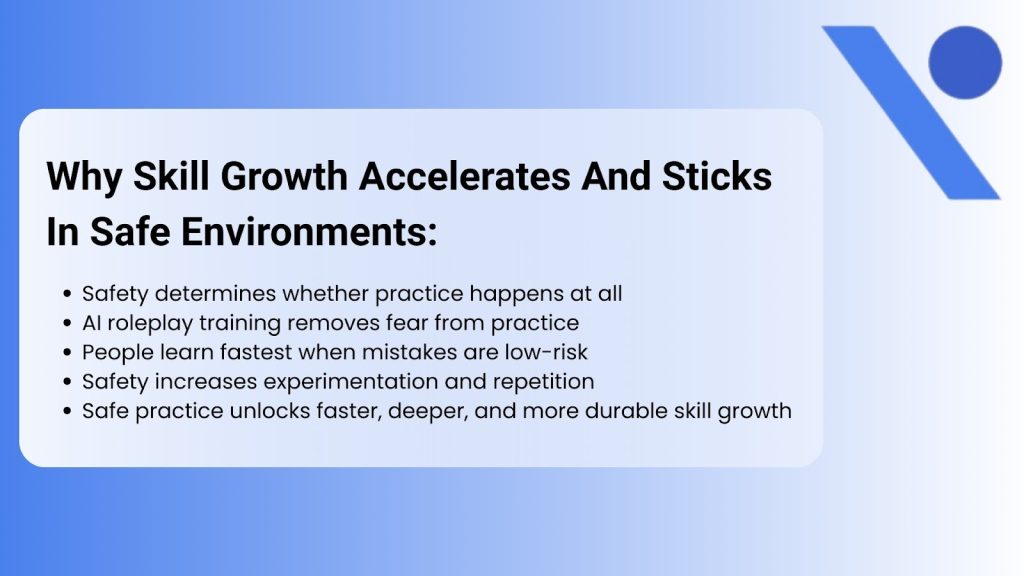
Practice is the engine of effective communication training. Safety determines whether practice happens at all.
AI roleplay training succeeds because it removes fear from learning. It preserves challenge while reducing social risk, enabling more repetition, faster feedback loops, and compounding improvement over time.
Organizations that prioritize safe practice unlock faster, deeper, and more durable skill growth. Get started for free today!
Frequently Asked Questions
What is AI roleplay training?
AI roleplay training uses artificial intelligence to simulate realistic communication scenarios so learners can practice on demand, receive structured feedback, and improve through repetition.
Why does psychological safety matter for skill development?
People learn faster when mistakes are low risk. Psychological safety increases experimentation and repetition, which are required for behavior change.
Why are safe spaces especially important for difficult conversations?
Feedback, conflict, and influence conversations naturally trigger threat responses. Without a safe practice environment, people avoid rehearsing the conversations they need most.
How is AI roleplay different from traditional roleplay?
Traditional roleplay depends on peer availability, comfort level, and social dynamics. AI roleplay removes social risk and makes practice repeatable, private, and consistent.
What makes AI roleplay effective, not just interactive?
Effective AI roleplay uses tailored scenarios, clear success definitions, meaningful metrics, and actionable feedback. Generic chatbots may simulate conversation but do not reliably build skills.
How do organizations get started?
Most start with targeted scenarios aligned to real work conversations, then expand as learners build consistent practice habits.