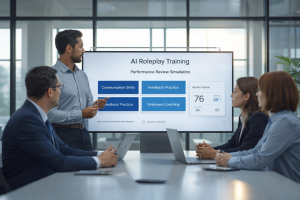

Leadership Development Is Breaking Traditional L&D Models
Managers are the most critical lever for performance, engagement, and retention inside organizations. They shape day-to-day experience more than strategy decks or company values ever will. Yet most managers are promoted without formal leadership development training and are expected to perform immediately.
In many organizations, individual contributors are hired for technical excellence and then asked to manage a team of other individual contributors. From day one, they are expected to give feedback, coach performance, handle conflict, and motivate others. Very few are equipped to do this well, and even fewer are coached themselves.
At the same time, demand for people skills and communication skills is increasing across the workforce. As AI absorbs more administrative and operational tasks, the human side of work matters more, not less. Leadership development training must now scale faster than traditional models were ever designed to handle.
This creates a core tension. Manager development must scale, but L&D teams are constrained by time, budget, and limited coaching capacity. One-size-fits-all programs are no longer sufficient. This is where AI coaching platforms begin to change what is possible.
Why Traditional Manager Training Programs Fail to Scale
Most organizations are not underinvesting in manager training programs. They are relying on models that were never designed for scale.
One-to-Many Training Creates Awareness, Not Capability
Workshops, courses, and leadership frameworks are effective at building shared language and awareness. They help managers understand what good leadership should look like.
What they do not reliably build is lasting behavior change.
Managers leave training knowing what to do in theory, but not how to do it in real conversations. Feedback discussions, performance check-ins, and emotionally charged moments do not unfold like case studies. Without practice, managers revert to instinct, avoidance, or overcorrection.
Leadership development training that stops at awareness produces insight without durable behavior change.
Burnout and Constraints Within L&D Teams
L&D teams are asked to support large numbers of managers with limited resources. Scaling traditional support creates compounding strain.
Common constraints include:
- Time-intensive scheduling for workshops and coaching sessions
- Reviewing recordings, call notes, and written reflections
- Inconsistent feedback quality across facilitators and coaches
- Limited visibility into whether manager behavior is actually improving
Even well-designed manager training programs struggle to show sustained impact because reinforcement and practice are difficult to deliver at scale. L&D teams end up managing logistics instead of driving outcomes.
The issue is not effort. It is infrastructure.
The Real Problem: Managers Are Asked to Coach Without Support
At the heart of the scalability challenge is a reality that explains why most manager training programs fail once managers return to real work.
The “Accidental Coach” Reality
Managers are expected to coach others from the moment they step into the role. They are asked to give developmental feedback, handle underperformance, and navigate conflict immediately.
Few managers receive training that prepares them for these conversations before they have to have them. Even fewer receive support in the moment when those conversations arrive.
An AI coaching platform cannot turn a new manager into a great leader on day one. What it can do is provide support that traditional workshops cannot. It offers realistic practice, immediate feedback, and in-the-moment coaching opportunities that meet managers where they actually struggle.
This is something most manager training programs simply do not provide.
Why Managers Avoid Practicing Leadership Skills
When managers do not practice, it is rarely due to a lack of interest. It is usually driven by a small set of predictable barriers.
- Fear of saying the wrong thing. Feedback and performance conversations feel risky, especially when relationships or credibility are at stake.
- Lack of a safe environment to rehearse. Practicing difficult conversations in front of peers or senior leaders often feels like an evaluation rather than learning.
- Lack of time. Managers are overloaded, and practice that requires scheduling, coordination, or additional meetings is easy to deprioritize.
Without safe, accessible practice, leadership skills stagnate even as expectations increase.
How AI Coaching Platforms Solve the Scalability Challenge
AI coaching platforms address the core constraint in manager development. They make high-quality practice possible without requiring proportional increases in human coaching time.
Customizable Roleplay for Real Manager Scenarios
Effective manager development requires practice that mirrors reality. AI coaching platforms support customizable roleplay scenarios aligned to the conversations managers actually face, including:
- Feedback conversations
- Performance and accountability discussions
- Difficult interpersonal situations
- Role-specific and level-specific leadership challenges
Scenarios can be tailored by role, seniority, and context so managers practice what is relevant to their work, not generic leadership scripts.
To see how this looks in action, the short walkthrough video below shows an example of coaching a manager struggling with team attrition.
Personalized Feedback Managers Can Act On
Practice without feedback does not create improvement. What differentiates AI-powered coaching platforms is the quality and consistency of feedback.
Managers receive actionable insights across multiple dimensions, including:
- Verbal clarity and message structure
- Vocal delivery and confidence
- Non-verbal communication signals that managers cannot easily self-diagnose
This feedback helps managers understand not just what they said, but how they showed up. Because feedback is delivered consistently and objectively, it reduces defensiveness and increases willingness to adjust behavior.
Consistency Without Micromanagement
One of the hidden challenges in leadership development training is inconsistency. Feedback quality varies widely depending on facilitator skill, coaching style, or manager relationship.
AI-powered coaching introduces standardized feedback frameworks across the organization. Managers practice against the same expectations and receive the same behavioral signals, regardless of who their direct manager or coach is.
This creates fair, repeatable development experiences without requiring micromanagement or increased oversight.
Calendar-Informed Practice Prompts
The future of AI coaching extends beyond static practice libraries.
With calendar-informed integrations, managers can be prompted to practice specific conversations ahead of upcoming meetings. Performance reviews, difficult one-to-ones, or sensitive team discussions become opportunities for targeted rehearsal.
This creates the possibility of a seamless coaching layer that knows what is coming up and supports preparation proactively. Practice becomes timely, relevant, and integrated into the flow of work.
How AI Coaching Platforms for Managers Generate ROI
Scaling leadership development is not just an L&D challenge. It is a business one.
AI coaching platforms generate ROI by decreasing cost, improving performance, and demonstrating measurable improvement.
Cost Efficiency
AI-powered coaching reduces reliance on external coaching and high-touch facilitation. Once implemented, the marginal cost of supporting additional managers drops significantly.
Organizations also get better utilization from existing leadership development training investments by extending learning beyond events into continuous practice.
Performance and Productivity Gains
When managers are better prepared, downstream effects compound.
Organizations see:
- Faster manager readiness
- Fewer escalations driven by poor communication
- More effective one-to-ones and team conversations
These outcomes are reflected in success stories such as our Headspace case study, where scalable coaching support helped improve leadership effectiveness while preserving human connection.
Measurable Leadership Development
One of the biggest challenges in leadership development training is proof.
AI coaching platforms provide data that links practice volume to skill improvement. Before-and-after assessments, usage patterns, and behavioral trends give L&D leaders stronger evidence for budget justification, renewals, and expansion.
An Implementation Roadmap for L&D Leaders
Scaling manager development does not require a complete overhaul of existing programs. It requires layering practice into what already exists.
Step 1: Start With High-Frequency Manager Scenarios
Begin with conversations managers face most often, such as:
- Feedback discussions
- Performance check-ins
- Difficult or emotionally charged conversations
High-frequency scenarios deliver the fastest value and drive early adoption.
Step 2: Embed AI Coaching Into Existing Programs
AI coaching works best as reinforcement, not replacement.
Use it to support practice before and after workshops, between coaching sessions, and during leadership transitions. This turns events into ongoing development journeys.
Step 3: Pilot, Measure, and Expand
Start with a single manager cohort. Track adoption, practice volume, and skill progression. Use results to build executive confidence and secure broader buy-in.
Teams can get started for free and explore AI-powered coaching with Virtual Sapiens.
Conclusion: Scaling Manager Development Without Burning Out L&D
Managers do not need more content. They need better support.
L&D teams cannot scale impact by working harder or running more workshops. AI-powered coaching platforms act as a force multiplier by making practice, feedback, and consistency possible at scale.
When managers are supported with realistic practice and timely feedback, leadership development training becomes more effective. L&D teams regain capacity to focus on strategy rather than survival. Organizations build leadership capability that actually shows up in daily work.
Frequently Asked Questions
What is an AI coaching platform?
An AI coaching platform uses artificial intelligence to support practice, feedback, and skill development through simulated scenarios, behavioral insights, and ongoing reinforcement.
How does AI coaching support leadership development training?
AI coaching extends leadership development beyond workshops by enabling repeated practice, personalized feedback, and measurable improvement over time.
Is AI coaching meant to replace managers, coaches, or trainers?
No. Effective AI coaching platforms augment human expertise by handling practice and baseline feedback so people can focus on insight and judgment.
How does AI coaching help manager training programs scale?
It removes dependency on scheduling, coordination, and limited coaching bandwidth, allowing more managers to receive consistent support.
How do organizations get started?
Most organizations pilot AI coaching with a small manager cohort, measure results, and expand once value is demonstrated.