
Most new managers want to give better feedback. They care about their teams and understand that feedback is part of their role. Yet in practice, feedback conversations often break down. Managers hesitate, soften critical points, delay conversations, or over-explain. What should be clear and constructive becomes vague or avoided entirely.
The issue is not intent. It is execution.
Traditional feedback training for managers focuses on frameworks, models, and examples. These are necessary, but they do not build fluency. Managers leave training knowing what good feedback should look like, but not how to deliver it when the conversation becomes uncomfortable or unpredictable. Communication training for new managers becomes effective when it moves beyond theory and into experiential learning, where managers practice before they perform.
Why Feedback Is the Hardest Leadership Skill to Master
Feedback Is Emotional, Not Just Informational
Feedback conversations are not neutral exchanges of information. They are emotional events that directly impact how people see themselves at work. Even well-structured feedback can trigger defensiveness, frustration, or uncertainty, especially when it challenges performance or expectations.
This creates a dual responsibility for managers. They must deliver a clear message while also responding to the emotional dynamics of the conversation in real time. Most new managers have not practiced doing both simultaneously, which is why feedback often becomes either overly softened or overly reactive instead of clear and constructive.
The Promotion Gap
Most managers are promoted for strong individual performance, not for communication skill. From day one, they are expected to set expectations, address performance gaps, navigate peer-to-manager transitions, and deliver difficult messages with confidence. These are not theoretical responsibilities. They are immediate and high stakes.
This creates a predictable gap. Managers are asked to execute complex communication tasks before they have had the opportunity to rehearse them. Without structured practice, they rely on instinct, which leads to inconsistency and avoidance.
Traditional Feedback Training for Managers Falls Short
Model-Heavy, Practice-Light
Most feedback training for managers follows a familiar structure. Programs introduce a framework, walk through examples, and include a short roleplay. This builds awareness and shared language, but it does not reliably build capability.
Understanding a feedback model is not the same as applying it under pressure. Real conversations rarely follow a script. Employees react in unexpected ways, emotions shift quickly, and managers must adjust in real time. Without repeated practice, managers revert to habits that feel safer, even when those habits reduce clarity.
Limited Repetition
Another limitation is the lack of reinforcement. Many manager training programs are one-time events with little follow-through. Managers rarely receive opportunities to practice repeatedly, refine their delivery, or receive feedback on how they come across.
As a result, common patterns persist. Managers avoid difficult conversations, soften messages that require clarity, or deliver feedback inconsistently across situations. Without repetition, behavior does not change, and training remains conceptual rather than practical.
The Case for Experiential Learning in Manager Training
Experiential learning shifts the focus from understanding feedback to executing it effectively. The goal is not simply to know what good feedback looks like, but to deliver it clearly and confidently in real conversations.
Effective experiential learning includes realistic scenarios that reflect actual manager challenges, safe environments where mistakes carry no real consequence, immediate feedback that highlights both strengths and gaps, and repetition that builds fluency over time. This combination allows managers to move from intellectual understanding to behavioral consistency.
Instead of asking, “Do you understand the framework?” the question becomes, “Can you execute it confidently?”
When managers practice in this way, they begin to internalize how to stay clear, composed, and direct even when conversations become emotionally charged. This is the difference between knowing a framework and being able to use it.
To see how simulation supports real manager development, watch the video below for an example of coaching a manager struggling with team attrition.
A Practical Feedback Framework for New Managers
Frameworks remain important because they provide structure. The difference is that they must be paired with practice to become usable in real situations. A simple framework can help managers structure feedback conversations with clarity and consistency:
Step 1: Clarify the Outcome
Define what behavior needs to change, why it matters, and what success looks like. Clarity prevents emotional drift.
Step 2: Anchor in Observable Behavior
Focus on specific actions and clear examples while avoiding assumptions about intent. Specificity reduces defensiveness.
Step 3: Invite Response, Don’t Debate
Ask for perspective and context. This maintains ownership while preserving accountability.
Step 4: Align on Next Action
Effective feedback ends with clear expectations, agreed next steps, and a timeline for follow-up.
Where AI Roleplay Training Strengthens Feedback Training for Managers
Frameworks provide structure. AI roleplay training builds fluency.
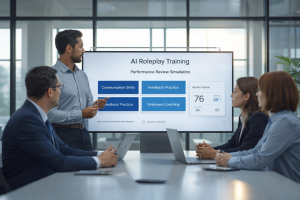
AI roleplay allows managers to practice a range of feedback scenarios that reflect real work situations. These include addressing missed deadlines, giving feedback on collaboration or tone, handling defensive reactions, delivering upward feedback, and navigating the transition from peer to manager. Practicing across these variations builds adaptability, which is essential because no two conversations unfold the same way.
What differentiates AI roleplay training is the feedback loop. Managers receive immediate, consistent insight into how they communicate, including message clarity, tone, pacing, confidence signals, and non-verbal behavior. This makes experiential learning measurable and actionable. Instead of guessing whether they improved, managers can see and refine specific behaviors with each attempt.
From One-Time Training to Continuous Skill Development
Communication training for new managers should not end after onboarding. Skill development requires ongoing reinforcement that is embedded into the flow of work.
Organizations can introduce short, focused practice sessions before performance reviews, between one-to-one meetings, after workshops, and throughout the first 90 days of a manager’s role. These sessions do not need to be long to be effective. What matters is consistency. Repeated practice builds familiarity, reduces hesitation, and increases confidence over time.
As practice compounds, feedback conversations become more natural and more effective. Managers spend less time preparing what to say and more time focusing on how to say it well.
Organizational Impact of Strong Feedback Skills
Improving feedback training for managers strengthens more than individual conversations. It improves how teams operate.
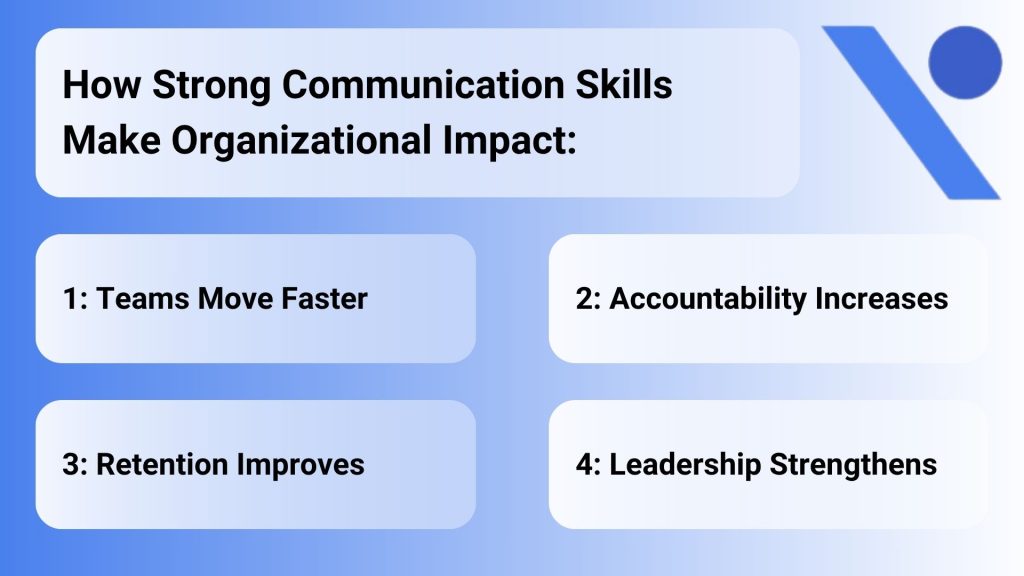
Clear feedback reduces ambiguity, allowing teams to move faster with fewer misunderstandings. Accountability increases because managers address issues earlier instead of avoiding them. Employees receive more actionable guidance, which supports development and improves retention. Over time, new managers become effective sooner, strengthening the leadership pipeline and creating more consistency across the organization.
Feedback That Works Is Built Through Practice
New managers do not need more theory. They need structured practice that prepares them for real conversations.
Feedback training for managers becomes effective when it combines clear frameworks, experiential learning, repetition, and behavioral feedback. This combination turns communication from an abstract concept into a reliable capability.
AI roleplay training provides the scalable practice layer that makes this possible. It allows managers to rehearse, receive feedback, and improve before conversations happen in real life. This is how communication training moves from knowledge transfer to leadership performance.
Frequently Asked Questions
What is feedback training for managers?
Feedback training for managers helps leaders deliver clear, constructive feedback that improves performance and strengthens relationships. Effective programs combine frameworks with structured practice.
Why do new managers struggle with feedback?
New managers are often promoted for individual performance rather than communication skill. They are expected to handle difficult conversations without enough practice or support.
What is experiential learning in manager training?
Experiential learning focuses on practicing real scenarios with feedback and repetition. It helps managers build communication skills through action rather than theory alone.
How does AI roleplay training improve feedback skills?
AI roleplay training provides a safe environment to practice feedback conversations and receive immediate feedback on delivery. This helps managers improve clarity, confidence, and communication effectiveness.
How often should managers practice feedback conversations?
Frequent, short practice sessions are more effective than one-time training. Practicing regularly helps managers build confidence and apply skills consistently in real situations.