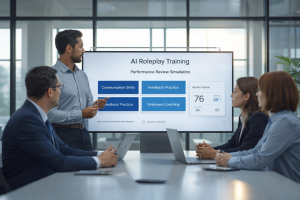

AI practice systems have proliferated quickly. Most organizations experimenting with communication or leadership development have encountered at least one, and most have noticed the same thing: the experience often feels shallow, inconsistent, or easy to abandon. Participants try a session, find it mildly interesting, and then never return. The technology works in the narrow sense (a conversation happens) but it doesn’t work in the meaningful sense. Skills don’t improve. Behavior doesn’t change.
The real question is not whether effective AI practice systems exist. It’s what separates a tool that genuinely develops skills from one that only simulates the appearance of practice.
The Problem With Baseline Bots in AI Practice Systems
Not all AI roleplay is created equal, and the gap between a well-designed AI communication coaching platform and a generic chatbot is significant. Many tools currently marketed as AI roleplay training are, at their core, thin wrappers around large language models. They can generate conversational responses, but they lack the structure, consistency, and behavioral depth that real skill development requires.
Common limitations of baseline bots include:
- Conversations that feel generic and low-stakes regardless of scenario
- No continuity between sessions, so every interaction starts from zero
- Feedback that is inconsistent, vague, or disconnected from structured evaluation criteria
- Minimal ability to define specific personas, tone, context, or difficulty
- No memory of prior interactions, performance history, or personal development arc
The result is a “try once, never return” experience. Initial curiosity gives way to disengagement, and the platform quietly becomes shelfware. For organizations investing in communication or leadership development, this outcome is entirely avoidable when the right design principles are in place.
Why Real Skill Development Requires More Than a Chatbot
Communication is not a knowledge problem. Most professionals already understand what good communication looks like. The gap is behavioral: showing up with clarity, confidence, and presence in real conversations, under pressure, consistently over time.
Behavioral skills are built through repetition, feedback, and progression, not through a single exposure or a one-off roleplay session. Real conversations are cumulative. People build context, recognize patterns, and adjust their behavior based on experience over time. Without that same accumulation in AI roleplay training, practice remains isolated and the learning loop never closes.
Generic AI tools treat each interaction as an event. Effective AI coaching platforms treat each interaction as a step in a longer development journey. That distinction is what separates tools that produce engagement metrics from tools that produce behavior change.
The Missing Layer: Continuity in AI Coaching
One of the most significant structural limitations of most AI communication coaches is the absence of continuity. Every session resets. There is no memory of what was practiced last week, no awareness of which patterns keep recurring, and no sense of how far a participant has come.
This breaks the learning loop. Skill development requires pattern recognition across time, not isolated practice events. A coach who works with a client over six months accumulates a nuanced understanding of that person’s tendencies, growth edges, and progress. AI roleplay that resets with every session cannot replicate that continuity, and without it, the experience feels like meeting a new coach every time.
This is precisely where purpose-built AI coaching platforms diverge from generic chatbots. Continuity is not a nice-to-have feature. It is a prerequisite for longitudinal skill development.
What Makes AI Practice Systems Feel Real: Key Design Principles
Building an AI roleplay experience that genuinely develops skills requires deliberate design across five dimensions. Each addresses a gap that generic tools consistently leave open.
1. Persistent Memory and Longitudinal Practice
Effective AI roleplay training builds on prior conversations. The AI retains context, past performance, and interaction history, creating learning journeys instead of one-off sessions. Users experience progressive challenge and skill refinement rather than starting from scratch each time. This sense of continuity and accountability is what keeps participants returning and what allows development to compound over time.
2. Deep Persona Customization
Real conversations are shaped by specific contexts, personalities, and stakes. Effective AI roleplay training requires the ability to define conversation scenarios precisely: who the other person is, what their history and motivations are, how they respond to pushback, and what the emotional stakes involve. Without this level of persona design, conversations feel artificial and the practice transfers poorly to real-world situations.
3. Structured, Consistent Feedback Systems
Feedback that changes randomly between sessions does not build trust or support learning. Effective AI communication coaching platforms provide standardized evaluation frameworks that assess performance consistently across verbal content, vocal delivery, and non-verbal behavior. Clear, actionable feedback tied to measurable criteria is what allows participants to understand where they are, what to adjust, and whether they are improving.
4. Guardrails and Enterprise-Ready Design
Unstructured AI can produce unreliable or inappropriate outputs, particularly in sensitive communication contexts like performance conversations, feedback delivery, or leadership scenarios. Enterprise deployment requires defined behavioral boundaries, alignment to coaching and communication best practices, and compliance with security and privacy standards. This is the difference between experimentation and production-grade deployment.
5. Engagement Loops That Drive Ongoing Practice
The biggest challenge in AI roleplay training is not access. It is sustained usage. Most participants disengage not because the tool is broken, but because there is no compelling reason to return. Effective platforms build engagement loops: timely practice nudges tied to real upcoming conversations, visible progress and improvement, and clear reasons to come back. When practice becomes part of the workflow rather than an additional task, adoption compounds.
The Between-Session Gap: Where Our AI Coach Assistant Steps Up
Even organizations using well-designed AI roleplay tools encounter a consistent pattern: participants engage strongly during a program launch or workshop, complete initial roleplays, and then drift. Without structure to sustain practice between live interactions, the momentum built in sessions evaporates within days.
This is a structural problem, not a motivation problem. Kolb’s learning cycle and more recent deliberate practice research are consistent on this point: lasting skill development requires repeated cycles of practice, feedback, reflection, and application. A single burst of activity at program launch is not enough. The platform must actively support re-engagement between human touchpoints.
This is the gap that the Virtual Sapiens AI Coach Assistant was built to close. Rather than waiting for participants to return on their own, the AI Coach Assistant automatically drafts personalized coaching emails and weekly practice plans for each participant based on their actual scores, session history, and progress. Facilitators review, edit, and send in minutes rather than hours. No manual tracking. No generic mass reminders. Each participant receives communication that reflects exactly where they are and what their next step should be.
For coaching firms and L&D leaders, this changes the ROI conversation entirely. Consistent engagement means more practice data. More practice data means stronger analytics. Stronger analytics means a defensible improvement narrative for renewal conversations and budget reviews. When participants stay active between sessions, the program produces outcomes, not just completions.
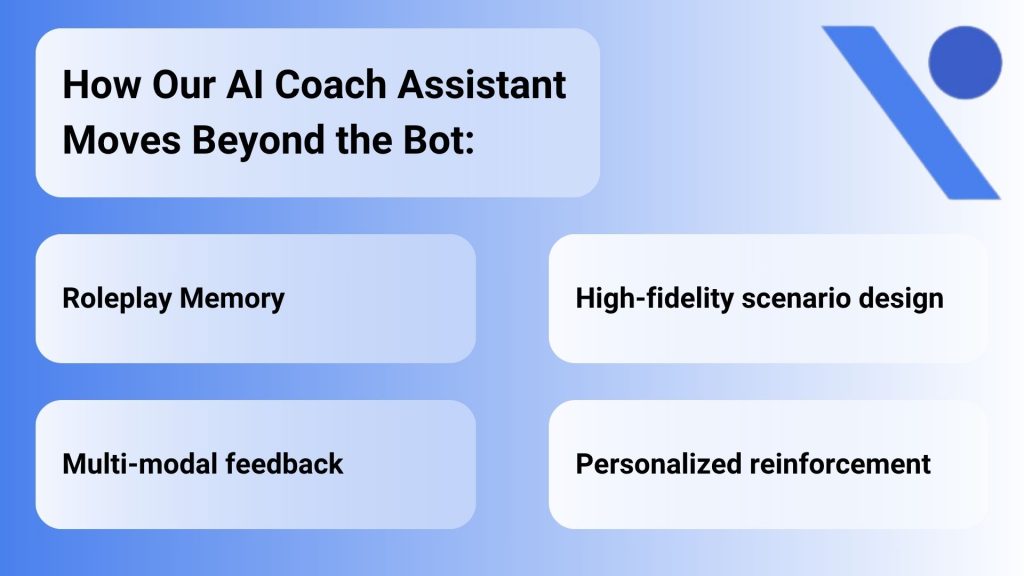
How Virtual Sapiens Moves Beyond the Bot
Virtual Sapiens is designed as a purpose-built AI practice system, not a generic chatbot repurposed for development contexts. Every layer of the platform reflects the design principles that distinguish real skill development from the appearance of practice.
Roleplay memory enables continuity across sessions. Conversations build on prior interactions and performance history, creating a consistent practice partner experience over time. Users are not starting over. They are progressing. Admins control whether memory is enabled and how it is scoped, ensuring that personalization never comes at the cost of privacy or security.
High-fidelity scenario design means customizable scenarios with defined context, history, adjustable difficulty, and multiple personas create realistic, high-stakes practice environments. Participants are not practicing against a generic AI. They are practicing against a colleague with specific motivations, a manager who tends to deflect, or an executive who needs evidence before engaging. That specificity is what makes practice transfer to real conversations. Institutions like Tallahassee State College have leveraged this scenario fidelity to build scalable communication practice programs that serve hundreds of students consistently.
Multi-modal feedback extends well beyond what is said. Virtual Sapiens analyzes vocal tone and pacing, non-verbal communication signals, and message clarity and structure, providing insights across the full spectrum of how communication is actually experienced by others. This is the depth that enables genuine behavioral change rather than surface-level improvement.
Personalized reinforcement through the AI Coach Assistant means practice does not stop when a session ends. Participants receive tailored follow-up based on their actual performance, not templates built for someone else, creating a consistent practice cadence that keeps skill development active between human touchpoints.
From AI Tool to Practice Partner: Why This Distinction Matters
Most AI tools are designed for interaction. Effective AI coaching platforms are designed for transformation. The difference shows up in every layer of the experience: one-off conversations versus continuous development, generic responses versus structured feedback, passive usage versus active engagement over time.
AI’s role in coaching and development is not to replace the human elements that make growth meaningful. The insight, the relationship, and the judgment that only an experienced coach or facilitator can provide remain essential. AI’s role is to extend practice, reinforce learning, and sustain engagement between those human interactions. When that division of labor is working, participants arrive at live sessions better prepared, coaches spend their time on depth rather than repetition, and organizations get programs that produce measurable skill improvement instead of positive survey responses.
The shift from chatbot to practice partner is simple to describe and significant in practice. It is the difference between a tool people try once and a platform people return to until their communication genuinely changes.
Conclusion: The Future of AI Roleplay Is Continuous, Not Episodic
AI roleplay training is no longer a novelty, but most implementations are still surface-level. The next generation of AI coaching platforms will be defined by continuity across sessions, realistic and high-stakes simulation, structured feedback tied to measurable criteria, and sustained engagement over time.
The shift is straightforward but profound: from chatbot interactions to longitudinal skill development. Organizations that make this shift will move from training events to genuine behavior change engines, and from completion metrics to outcomes that hold up in the real world.
Get started with Virtual Sapiens today and experience the difference between a bot and a true practice partner.
Frequently Asked Questions
What is AI roleplay training?
AI roleplay training uses artificial intelligence to simulate realistic communication and leadership scenarios so learners can practice on demand, receive structured feedback, and improve through repetition. The most effective implementations go beyond conversation simulation to provide continuity, persona depth, and behavioral feedback across verbal, vocal, and non-verbal dimensions.
What makes an AI coaching platform different from a chatbot?
A chatbot generates responses in a single session. An AI coaching platform is designed for longitudinal development, retaining session history, building on prior performance, providing consistent structured feedback, and actively sustaining engagement between sessions. The distinction matters because behavioral skill development requires continuity, not isolated interactions.
Why do most AI roleplay tools fail to drive behavior change?
Most tools treat each session as a standalone event. Without continuity, structured feedback frameworks, or engagement loops that bring participants back consistently, practice remains episodic and the learning cycle never closes. Behavior change requires repeated practice over time, not a single well-designed session.
What is the AI Coach Assistant?
The Virtual Sapiens AI Coach Assistant automatically drafts personalized coaching emails and weekly practice plans for each participant based on their actual scores, session history, and progress. It removes the manual burden of managing cohort engagement, keeping participants active between sessions without adding operational workload for coaches or facilitators.
How does non-verbal feedback improve communication training?
Communication effectiveness is shaped as much by how something is delivered as by what is said. Feedback on vocal tone, pacing, eye contact, and non-verbal signals helps learners identify and correct blind spots that verbal feedback alone misses. This is one of the most persistent gaps in traditional communication training and one that AI coaching platforms with multi-modal analysis are uniquely positioned to close.
Is AI roleplay training appropriate for enterprise use?
Yes, when the platform is built for it. Enterprise deployment requires defined behavioral guardrails, consistent feedback frameworks, and compliance with security and privacy standards. Purpose-built platforms meet these requirements; generic chatbots typically do not.
How do organizations get started with Virtual Sapiens?
Most organizations begin with a targeted pilot, a specific cohort, role, or use case, and expand once value is demonstrated. Visit the get started page to explore the platform and connect with the team.