
AI Roleplay: Boosting ROI of Instructor-Led Programs in 2026

Why Training Is at an Inflection Point Instructor-led communication and leadership programs are at an inflection point. Demand for strong communication, leadership presence, and presentation skills is rising across roles and industries. The rise of AI in the workplace positions these “soft skills” as a critical differentiator for effectiveness in all roles across the workforce. At the same time, organizations face increasing pressure to adopt AI in ways that meaningfully reduce cost, improve outcomes, and scale impact. In-person communication training remains familiar and valuable, but it is also increasingly difficult to scale. For coaches, trainers, and L&D leaders, the central question in 2026 is no longer whether to use AI, but where real ROI actually comes from. The answer is not more content or more events. It’s practice. What ROI Really Means in Coaching and Training Programs Historically, training ROI was measured through attendance, satisfaction surveys, or workshop completion rates. Those metrics no longer hold up. Today, organizations care about outcomes such as: Communication sits at the center of leadership effectiveness, yet it’s one of the hardest skills to build and measure. Real ROI comes from systems that help people practice consistently, receive feedback, and improve over time, not from one-off learning moments. The Traditional Model: In-Person Communication Training Instructor-led programs typically rely on workshops, facilitated roleplay, live coaching, and group training formats. These experiences still add value through human connection, shared language and alignment, and peer-to-peer learning. However, there are structural limitations that directly impact ROI. In-person training is often a one-time exposure with limited follow-through. Scheduling and coordination make it difficult for participants to practice regularly, especially with peers. Practice quality depends heavily on participant comfort, acting ability, and willingness to roleplay. Feedback quality varies based on facilitator skill or peer expertise, and the burden of improvement falls largely on the participant once the session ends. The AI Roleplay Training Model: Supporting Instructor-Led Programs AI roleplay training changes the equation by supporting and extending instructor-led programs rather than replacing them. It provides on-demand, repeatable practice aligned to real communication scenarios. Participants can complete short 10-minute roleplays, log their sessions, and bring insights back into workshops or coaching conversations. The efficiency gains are immediate. Removing one human from a two-person roleplay reduces the labor cost of the activity by half. Minute-for-minute, AI roleplay training delivers more feedback in less time, accelerating learning without increasing facilitator workload. Trainees experience consistent scenario quality through AI-driven personas and are no longer dependent on teammates’ availability or skill level, while trainers gain an AI coaching platform that supports both their delivery process and their learners’ long-term skill retention. Quality of Practice: Where Training Succeeds or Fails Practice quality determines whether training succeeds or fails. Poorly executed roleplay can be counterproductive. Common risks in traditional roleplay include unrealistic scenarios, uneven difficulty, and feedback from people without a clear definition of what success looks like. AI roleplay training addresses these challenges by offering consistent persona behavior, adjustable scenario complexity, exposure to diverse communication styles, and standardized performance expectations. With Virtual Sapiens’ AI Roleplay, practice becomes more realistic, repeatable, and aligned to real-world leadership scenarios. When practice is structured and repeatable, learners build confidence faster and transfer skills more reliably into real-world situations. What’s Been Missing in Communication Training: Non-Verbal Skills Communication effectiveness goes far beyond words. Leadership presence is shaped by a range of non-verbal behaviors that are rarely addressed consistently, including: Coaches, trainers, and managers often lack the time to identify and correct these blind spots at scale. An AI communication coach can pinpoint these non-verbal signals, giving learners a private space to practice and improve repeatedly. This is how AI Roleplay enables learners to refine non-verbal behaviors consistently, without the pressure of live evaluation. This closes one of the most persistent gaps in communication training. Coach, Trainer, and Manager Enablement: The Hidden ROI Multiplier Coaches, trainers, and managers are the most constrained resources in development programs. In-person training often increases their workload through recording reviews, repetitive feedback, and logistical overhead. AI coaching platforms support enablement by handling repetition and baseline feedback, surfacing where human insight is most needed, and reducing time spent reviewing recordings. When coaches and trainers are better enabled, ROI multiplies across programs and human expertise is applied where it has the greatest impact. Virtual Sapiens enables coaching at scale, reducing repetitive workload while increasing strategic coaching impact. Scaling in-person communication training is difficult with distributed teams, multiple roles, and growing participant volumes. Consistency becomes nearly impossible. AI roleplay training provides a consistent practice layer with the same scenarios, standards, and feedback across the organization. Over time, consistency matters more than perfection, enabling sustained improvement and reliable ROI. Conclusion: ROI Comes From Practice, Not One-Off Events Communication skills improve through repetition, feedback, and confidence, not through isolated training moments. In 2026, ROI favors systems that scale practice rather than isolated training moments. AI roleplay training provides that system. When implemented intentionally, it transforms instructor-led programs from one-time experiences into engines that improve leadership communication over time. Virtual Sapiens enables better communication outcomes with less time, lower cost, and measurable impact, turning practice into performance at scale. Organizations can get started for free and experience how AI-supported practice fuels sustained behavior change. Frequently Asked Questions What is AI roleplay training? AI roleplay training uses artificial intelligence to simulate realistic leadership and communication scenarios so learners can practice on demand. It provides repeatable practice, consistent scenarios, and structured feedback that traditional roleplay and workshops can’t scale. How does AI roleplay training improve ROI in instructor-led programs? AI roleplay training improves ROI by enabling faster skill development, sustained behavior change, better use of coach and trainer time, and measurable improvement over time. It extends learning beyond workshops and turns training into ongoing practice. Does AI roleplay replace instructors, coaches, or trainers? No. AI roleplay supports instructor-led training rather than replacing it. It handles practice, repetition, and baseline feedback so coaches, trainers, and managers can focus on insight, judgment, and high-impact coaching conversations. Why
A Practical Guide to AI Roleplay Training

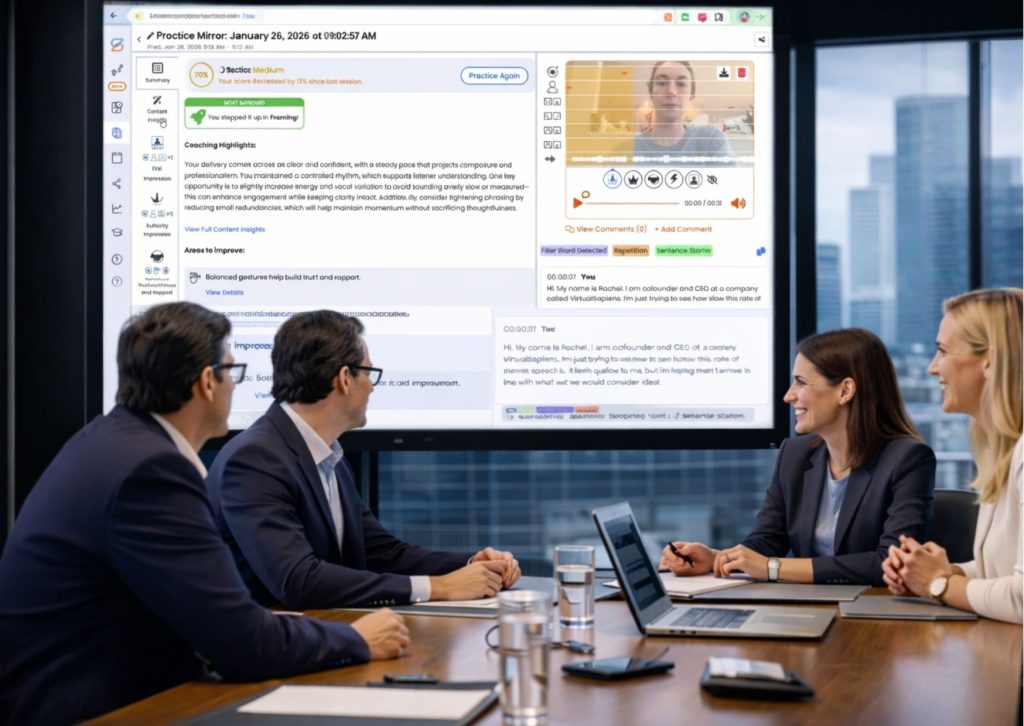
Why AI Roleplay Is Becoming Essential For Managers, Trainers, and Coaches Leadership communication has become one of the hardest skills to develop at scale. Managers are expected to coach without formal training or time. Trainers are under pressure to prove that leadership programs actually change behavior. Coaches are stretched thin as demand grows faster than their capacity. At the same time, organizations face mounting pressure to adopt AI in ways that reduce cost without sacrificing trust, rigor, or the human element of development. Traditional leadership training models like workshops, peer roleplay, call reviews, and one-to-one coaching were never designed for today’s constraints. They are slow, difficult to scale, and notoriously hard to measure. AI roleplay training has emerged not as a futuristic experiment, but as a practical response to these realities. The real question is no longer whether AI belongs in leadership development, but how to implement it responsibly, effectively, and at scale. What AI Roleplay Training Solves in Leadership Development Leadership communication is not a knowledge gap; it is a strategic skill. Most managers, trainers, and coaches already understand what effective leadership should look like. The real challenge is maintaining behavioral consistency: showing up with clarity, confidence, and presence in real situations, under pressure, over time. In-person and virtual presentation skills training programs are geared towards goals like executive presence, feedback delivery, and influence. These skills are built through repeated practice, not insight alone. Without rehearsal and reinforcement, even the strongest training experiences fade quickly once participants return to their day-to-day work. Time is the universal constraint across leadership development. Managers lack the capacity to coach consistently. Trainers cannot provide individualized feedback at scale. Coaches cannot review unlimited recordings or add sessions without burning out or increasing costs. Human-only roleplay and call reviews are inherently inefficient, requiring coordination, scheduling, and significant facilitator involvement. AI roleplay fundamentally changes the economics of practice. Short, focused roleplay sessions can happen on demand, without scheduling overhead. Minutes of AI-supported practice replace hours of coordination, allowing leaders to practice daily instead of quarterly. This increase in practice volume and efficiency is what enables sustained behavior change and results, boosting skills for in-person and online presenting. How Virtual Sapiens Makes AI Roleplay Training Effective For AI roleplay to meaningfully improve leadership communication, it must mirror the real world. Virtual Sapiens delivers on-demand AI roleplay for real leadership and presentation scenarios, enabling leaders to practice feedback conversations, executive presentations, and high-stakes discussions exactly as they occur on the job. The Virtual Sapiens platform also analyzes verbal content, vocal delivery, and non-verbal behavior, recognizing that leadership presence is shaped as much by how something is delivered as by what is said. This non-verbal communication analysis is a core differentiator, one that most generic AI tools simply don’t offer. Virtual Sapiens is designed for compounding practice and sustained improvement, not one-off scores. Leaders and organizations gain progress tracking at both individual and group levels, providing visibility into skill development over time and aggregated insights that show whether leadership programs are actually working. Just as important, Virtual Sapiens is built for trust. Our robust pre-existing AI infrastructure meets SOC 2 Type II and GDPR compliance standards, addressing the real security, privacy, and compliance risks of using generic AI for sensitive leadership conversations. This is the difference between an experimental AI tool and purpose-built, enterprise-ready infrastructure, and why organizations choose Virtual Sapiens as a long-term technology partner for leadership development. A Role-Based Guide to Using AI Roleplay Training Managers: AI Roleplay as the “Perfect Manager Buddy” Managers are increasingly expected to coach, yet many are promoted without formal coaching training or the time required to review recordings and give consistent feedback. As a result, coaching quality varies widely, and managers often lack visibility into how their teams are developing over time. AI roleplay provides managers with a structured way to support development without adding significant workload. With Virtual Sapiens, employees can practice realistic, customizable roleplay scenario options independently, while managers gain access to unparalleled non-verbal insights and solutions that highlight strengths, gaps, and trends both individually and across their teams. This approach is illustrated in our Headspace case study, where AI roleplay helped scale coaching quality while preserving the human connection. Results for Managers Managers can try it themselves for free and explore how structured practice fits into our Practice Portal. Trainers: Making Leadership Workshops Stick Leadership workshops require significant investment, yet too often deliver limited long-term skill transfer. Trainers face constant constraints on staff, time, and resources, making it difficult to reinforce learning after the event. Without structured practice, accountability, and clear proof of impact, even well-designed programs struggle to maintain lasting behavior change. Virtual Sapiens extends workshops into a continuous practice solution that maps directly to the learning journey. AI roleplay before and after workshops allows participants to rehearse real leadership scenarios aligned to program objectives, turning concepts into applied skills. Trainers gain visibility into whether management and leadership training is actually working, with data that tracks behavior change over time. The result is a shift from one-time, event-based training to behavior-based development that sticks. This shift is highlighted in our BTS case study, which shows how continuous practice transforms leadership training outcomes. Results for Trainers Trainers can try AI roleplay for free as part of a broader enablement strategy, and can use AI roleplay before workshops to track and report progress. Coaches: Scaling Without Replacing the Human Element Coaches face a structural scaling problem: their impact is tied directly to their availability. Clients often fail to practice consistently between sessions, and coaches spend valuable time reviewing repetitive foundational material rather than focusing on deeper insight and strategy. Virtual Sapiens’ AI coaching platform acts as a companion between live sessions, providing a safe, judgment-free environment to practice real conversations while handling repetition and baseline feedback. By “riding alongside” clients between sessions, coaches can focus their live time on depth, insight, and strategy. AI is not a replacement, but rather an augmentation that streamlines and enhances coaches’ existing
AI Coaching – Personalized, but not Manipulative

Dr. Abbie Maroño, PhD and I discuss the fine line between using AI Coaching to empower self-possesed improvement and manipulating behaviors. Therefore, here are some takeaways: 💡 AI Coaching: Personalized, Not Robotic In fact, this allows professionals to receive feedback that reflects their communication style, avoiding everyone from becoming “robotic” and prescriptive with in their behaviors. 💡AI The Perfect Ally for Human CoachingNot everyone can afford in-person coaching, and AI offers a more affordable alternative. But it’s about using AI to simulate human coaching, based on recognized non-verbals, allowing users to adapt them naturally. 💡Reflect, Practice & Integrate Learning and mastering non-verbal communication is a process. It involves reflection and practice—two stages where Virtual Sapiens excels. Firstly, users can embrace continuous learning, gradually refining their behaviors until they become second nature, much like developing non-verbal muscle memory. 💡Real Change Takes Time Mastering non-verbal communication and communication in general, like any skill, requires consistent practice over time. For example, Abbie states that users should aim for a 6-month to 1-year period of regular practice to be able to integrate these behaviors fully, in effect they can focus on other aspects of communication without overthinking. At Virtual Sapiens, we’re committed to helping you improve your communication style in a way that feels natural and personalized. Give this short video a listen for more insights! https://youtu.be/nX4aVcVZupw
Hybrid Work Policy Hot Topics – Evolving Workplaces

Dr. Abbie Maroño and I get real about hot topics related to today’s evolving workplaces. In this convo, we discuss: the ongoing debate around remote work, how companies can adapt to hybrid work models, and innovative ways to build relationships with colleagues and clients in a virtual environment. Key Discussion Points: Why “return to office” policies might not be realistic anymore. Effective strategies to foster connection and motivation in remote teams. How turning your camera on can make a BIG difference in engagement!! The importance of flexibility for different stages of life, particularly for working parents. Creating social opportunities in virtual settings to combat feelings of isolation. If you are a team leader looking to improve team dynamics or an employee dealing with the challenges of hybrid work, get ready to take some notes to help you thrive this new digital era! https://www.youtube.com/watch?v=jP7nOT52tEU&feature=youtu.be
The State of Business Communication – 2024
Every year, Grammarly and The Harris Poll join forces to conduct a comprehensive review of trends in workplace communication. Unsurprisingly, this year’s focus is on the impact of Gen AI as a tool to manage communication and information overload. In the full report, which you can download here, you will find some fascinating data on the real value of Gen AI among other things. From our perspective at Virtual Sapiens, while we use elements of Gen AI in our application, we leverage AI from a coaching and behavioral analysis perspective. When we read this report, we are teasing out trends in how companies are dealing with the challenges in miscommunication and measuring the appetite of companies to invest in the kind of training we offer to elevate communication effectiveness across their organizations. Here are our main takeaways this year: ✅ Communication in aggregate as well as the channels over which we communicate are on the rise. Being fluent across all channels is a new priority. ✅ Meetings (virtual and in-person) continue to dominate the communication landscape. Making communication behaviors and skills of the utmost importance on video, and off. ✅ Across all channels, effective communication positively affects employee morale and confidence, productivity and customer satisfaction. ✅ Across all channels, poor communication negatively affects productivity, extends timelines and costs more money to get to the finish line. ✅ The majority of skills building and communication effectiveness exists at the top of the organization. This means we need to leverage tools like Virtual Sapiens to address the skills gap knowledge workers feel across companies. ✅ 66% and 72% of knowledge workers and leaders respectively wish their organizations would invest in tools to help them communicate more effectively. In conclusion and as mentioned in the report, the time is now to invest in solutions that offer effective upskilling not just for the c-suite, but across the organization. Communication misfires increase exponentially from one person to the next, like broken telephone. Solutions like Virtual Sapiens can help ensure that messages land as intended. As always, while the impact of communication can sometimes feel hard to measure, it’s helpful to keep in mind that the act of communication is at the core of everything knowledge workers and leaders do. It is time to harness more than just Gen AI to help humans communication more effectively.
Virtual Sapiens Named Cool HR Tech Startups 2024

The term ‘Future of Work’ is dynamic. Every day it seems new data enters the scene that supports new trends, updated work from home/the office policies, hiring and firing data and so on. One of the most constant trends from what we have seen and researched, is the need to ensure communication channels are open and effective. Video has presented itself as another constant and our Presence Portal and AI coaching software is becoming increasingly relevant to leaders and professionals across the globe. Turns out, we aren’t the only ones to think so! It is an honor to be included in the inaugural Cool HR Tech roundup of 7 emerging technologies. Chris Harvey is a seasoned HR guru – he knows his stuff and he understands the trends deeply. As he states in our feature: “The benefits of Virtual Sapiens solutions transcend team communication to positively impact your ability to become a better presenter in every environment including customer calls, sales calls, senior leadership presentations on video, and off.” You can check out his full round up on his website directly. For anyone in HR tech, he is one to follow.
Analyze what you say with Virtual Sapiens Content Analysis AI

To date, we have focused on developing the most nuanced and personalized feedback on nonverbal/visual and vocal elements of communication. As you likely noticed, the verbal side of AI analytics took the world by storm in the latter part of 2023. We are now in a position to adopt some of this new technology to support our community of users with even more well-rounded communication feedback. To kick off 2024, we are thrilled to share a robust suite of communication coaching through our Presence Portal. The new Virtual Sapiens experience provides immediate feedback on all the unique, behavioral details that set our platform apart, with the addition of quality feedback on your content. To give you an idea, here is what this will look like for our Teams level users: https://www.youtube.com/watch?v=Xq4vQ8nz078&feature=youtu.be For any Simulated Conversation, Practice Mirror or uploaded video content, our AI will give you feedback on what went well, areas to improve and even possible rewrites for new ideas. As with any feedback (AI or human-delivered), it’s important to take some time to first digest the information. What do you agree with, what do you disagree with? What are the main takeaways and how will you integrate the feedback moving forwards? We are excited to include verbal and content analytics in our plan for Teams (individuals are able to access this as well). For more information, visit our plans page here and get in touch:)
The Consequences Of Poorly Run Video Meetings
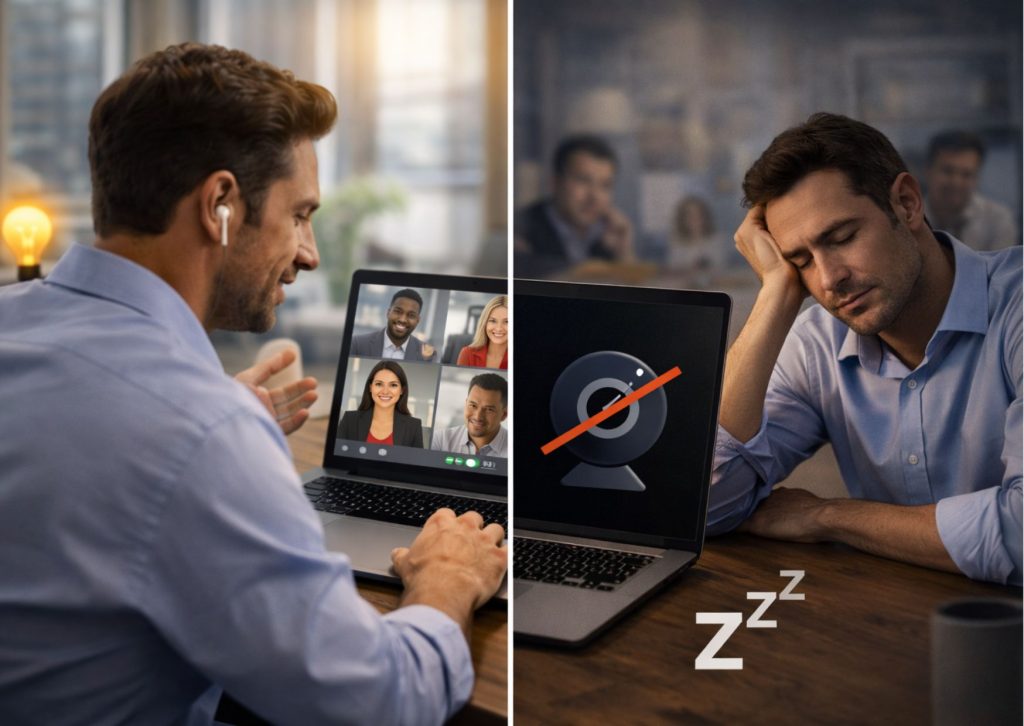
The Wall Street Journal recently came out with an interesting article covering a study by Nature on the neurophysiological perspective of video conferencing in an academic environment. As always, it is imperative to go straight to the primary source when such articles come out. The article by Nature is fascinating and highlights a few key points we must take into consideration. 🧠 This is the first study conducted with real scientific rigor, versus the self-reports we have relied on to date. Perhaps not surprisingly, the study supports self-reports: video conferences that are poorly run and trying to simply ‘replace’ in-person interactions cause pretty real fatigue. 🧠 Video conferencing fatigue (VCF) is defined as “somatic and cognitive exhaustion that is caused by the intensive and/or inappropriate use of videoconferencing tools”. 🧠 When comparing a virtual events in an academic environment to the same events conducted in person, the results are conclusive – the in-person version of the event was an energizer, the virtual version caused an overload in cognitive stress and led to a feeling of exhaustion. 🧠 The study also highlights a few important limitations: The scenario under study (an academic environment fueled by interaction and professor/student back and forth) is a specific type of communication event. The group was small, 35 people who had opted in to the study. The virtual experience was conducted in a controlled environment, not in a remote office set up There were no parameters around the actual skill the professor had in running the virtual event. If we take the very definition of VCF itself, we notice a few critical key words being the ‘insensitive and or/inappropriate use’ of video. As I have mentioned in the past, video is not an appropriate tool for everything. For some things, video can be extremely effective. For other things, like for instance, for academic sessions meant to be discussion and brainstorming based, video can be a drag unless you have a master facilitator. Which, we know is simply not the case with most university professors and educators on video. There is a lot of nuance that must be taken into consideration in a study like this. I think the researchers did a great job in identifying the limitations to this relatively small study. What we must be wary of is other people’s tendencies to make snap judgements that are not accurate. As with any study, the reader is left wondering….so what does this mean for me? I think the following quote in the conclusion section of the study answers this question succinctly: “As it is unrealistic to recommend completely abstaining from the use of videoconferencing tools, the future study of effective countermeasures to reduce the fatigue and stress potential of videoconferencing will be critical for sustaining human well-being and health in an increasingly digital world.” And in my opinion, this is where Virtual Sapiens comes in 😈.
SBF – An Analysis by Virtual Sapiens AI
One of the most powerful ways to learn and grow is through comparative analysis. Especially when it comes to improving your communication and presence, being able to analyze and measure the way you show up and communicate under different scenarios is a powerful tool in understanding yourself, and gaining control over the impression you are sending others. Virtual Sapiens makes this all possible with our three distinct ways of getting immediate feedback. We wanted to show you a compelling example of this in action with our Video Upload product. Context: Sam Bankman-Fried (SBF) was recently found guilty on 7 criminal fraud charges. We found a public video interview with SBF from before the hearings, and were curious what our software would pick up on. What we found is fascinating and indicative of the major differences of impression people can send even throughout a single interaction. You can see the full video here for yourself. We have highlighted two distinct segments which seem to divide the content. Segment One: SBF when he is pitching about his vision/selling his ambitions vs. Segment Two: SBF when he is backtracking his involvement/absolving himself from being implicated in the fraud that transpired and lost investors billions of dollars. Let’s take a closer look… Above is a screenshot of SBF’s Virtual Sapiens results from a time slice of him pitching his company. You can see the clip for yourself here. When SBF is pitching his company and vision, he exudes confidence, trustworthiness and energy. It’s interesting to note that SBF was very successful in convincing a huge number of very smart people to invest with his company and trust him with their significant assets. Clearly the way he would deliver his messages under this context was compelling and we can see that Virtual Sapiens confirms this. Now let’s take a look at Segment number two. This is a screenshot of Virtual Sapiens’ analysis of SBF during a clip of the interview when he is trying to defend his ‘lack’ of involvement and knowledge of what was happening ‘under the hood’. You can see the excerpt for yourself here. What. A. Difference. Here, we see his presence plummet. We see his markers of trustworthiness significantly decline as well as his impression of authority and energy. Even SBF’s framing changes because his posture shrinks and he takes up less space within the frame and shows up in the lower half of the frame instead of the upper third as best practice prescribes. Watching this clip also makes me think we should develop some models around leg shaking/bouncing… What does this tell us? Importantly, we are not claiming that Virtual Sapiens is a lie detection software. However, what this analysis highlights is the following: ❗This type of analysis can be especially effective in establishing a baseline, from which you can track changes in impression management based on changes in specific behaviors. ❗ Virtual Sapiens is an effective tool in comparing the same individual across multiple scenarios or communication events. ❗ While this is a drastic and somewhat dramatic example based on the subject matter and individual, this type of exercise is exceptional when you think about the applications for refining pitches, presentations, and analyzing the impression you are sending through your presence and communication. To note, this analysis focuses more on how SBF is showing up, rather than what he is saying. The added context of course is critical and our new suite of tools allows users to specify which analysis is tied to which scenario and includes transcription. If you are curious about your own performance, reach out. We’d be happy to get you set up with a trial account!
How to Boost Trustworthiness and Build Rapport on Video

Episode 4 of Conversations in the Future of Work is LIVE! This week, we welcome renowned behavioral scientist and Director of Education at Social Engineer, Dr. Abbie Maroño, PhD. In this episode we discuss the concept of building trust and rapport in virtual environments as work transitions more towards a virtual atmosphere post pandemic. Dr. Abbie emphasizes the crucial distinction between trust and rapport and also explains the importance in managing one’s nonverbal cues to be perceived as trustworthy. Interestingly, being perceived as trustworthy, does not make you a trustworthy person – But why leave the perception of trustworthiness on the table? Overall, this episode provides the audience with valuable insights and strategies to create more meaningful and effective relationships and navigate the challenges of the virtual environment. https://youtu.be/P2aKFB8wYww